

The next generation of surgical robotics technology is set to soon enhance the healthcare experience for both patients and medical teams in the operating rooms at the QEII Health Sciences Centre.
Donors to the QEII Foundation are coming together to support acquiring a da Vinci Xi robot, the newest model of Atlantic Canada’s first surgical robot — da Vinci X — which generous gifts of all sizes made possible in 2019.
The new robot will continue to help those in need of procedures to fight a variety of cancers. It will also allow healthcare teams to treat more patients with even greater precision, across more specialties.
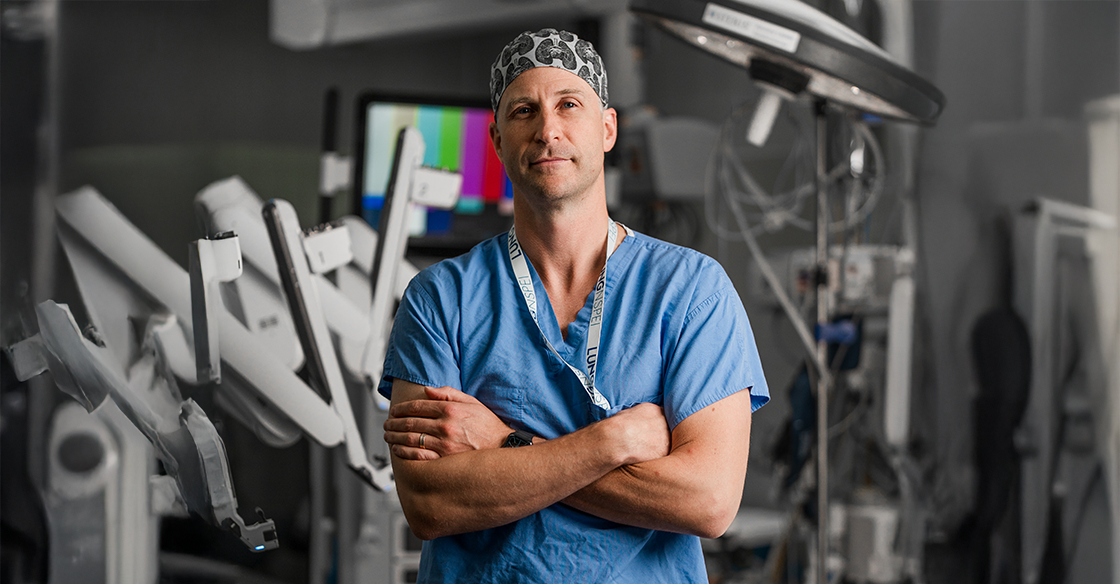
In this Q&A, Dr. Alexander Ednie shares how the precision of the da Vinci Xi may be a game changer for his patients.
Q: What inspired you to specialize in thoracic surgery?
Dr. Ednie: A couple of things attracted me to this specialty. You get to operate on multiple areas of the body — the neck, the chest, the belly. There are a lot of minimally invasive surgeries you can do in this area, which is nice and hopefully, with the robot, we’ll be able to push that boundary a little bit. I have always been interested in treating cancer — it’s a terrible disease, but also very fascinating as it always kind of evolves a little bit. It keeps it very interesting.
Q: How do you hope the da Vinci Xi will positively impact your patients and the surgical team?
Dr. Ednie: From the surgeon’s perspective, I’m excited about the data the da Vinci Xi gathers to allow us to be the best we can be at our jobs. For thoracic surgery patients, I think the biggest benefit will be the types of surgeries that we will be able to do through little incisions. They typically have a shorter hospital stay. It’s a more comfortable surgical option with less pain post-op, so hopefully their hospital stays can be shorter as a result. I think ultimately, the patient experience could potentially be a little bit more streamlined and a bit more efficient being in hospital. On the training side of things, having a da Vinci Xi is going to bring the QEII as a teaching hospital up to speed with the other big academic centres. With AI in health care taking off exponentially, I see an opportunity to integrate that into cancer care a lot more effectively with this robot. I think there's tons of opportunities with the robot and its new technology.
Q: How have you seen the usage of robotics change in your time as a surgeon?
Dr. Ednie: When I was training in Ontario, they had a super old version of the robot which I would assist with. It was during COVID, so I didn’t get a ton of time on the robot. At that time, the robot seemed clunky, and the technology was old. There may have been a couple of surgeons who enjoyed using it, but it just seemed to add time to tasks. People weren’t as enthusiastic about using it. But now technology is faster, and the robot is easier to get into place. It will be very efficient in the operating rooms. The arms move more effectively, and the visualizations are way better — it's evolved dramatically.
Q: When it comes to the vision of having Canada’s first Centre of Excellence in Robotic Surgery, how does that make you feel?
Dr. Ednie: I'm very excited about it. Truth be told, at first, I wasn't sure what to think of it. But since we started working with the da Vinci X robot that QEII Foundation donors bought, I've gotten very excited about it. The QEII team is very keen to make this happen and is very pro-robot.
Q: What benefits are you hoping your thoracic surgery patients who can have surgery with the da Vinci Xi may see?
Dr. Ednie: I think my patients may see the biggest benefits in terms of post-op recovery if we can keep the surgery minimally invasive with the robot, which the data seems to suggest with the da Vinci Xi. It’s a matter of if we can use the small cuts for thoracic surgery or if we have to go in through a big incision — a thoracotomy is probably one of the most painful incisions you can do to someone. Sometimes it is necessary, but again, if the da Vinci Xi helps reduce the likelihood of a thoracotomy, the patient certainly wins.
Q: Do you think the da Vinci Xi will help with recruiting and retaining doctors here?
Dr. Ednie: Yes, I think it's going to have a big impact on our ability to recruit people. Most doctors going through thoracic training programs now will have exposure to cases robotically. If they were to end up here and couldn’t maintain their robotic skills, they may start questioning their decision. So, I think this is a big step in the right direction for us in terms of recruitment—this may make us more attractive and more competitive when it comes to hiring.
Q: What would you say to donors or anyone thinking of donating towards the new da Vinci Xi?
Dr. Ednie: To those who have already donated, thank you so much for helping us with patient care and moving the needle towards better care. It’s a wonderful opportunity to put Halifax on the map in terms of surgical and academic excellence. It’s also a great opportunity to have a big impact on patient care. We have very high rates of cancer here in Nova Scotia, especially lung cancer compared to the rest of Canada. I’m hopeful the da Vinci Xi can have an impact on those patients. Your gift will be a gift to others.