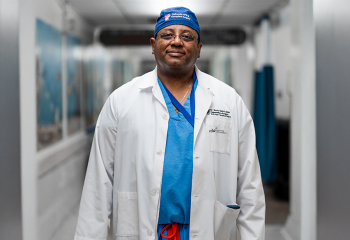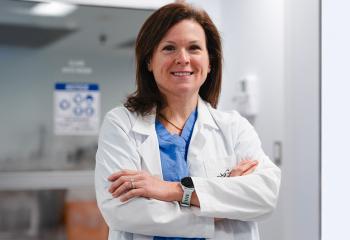


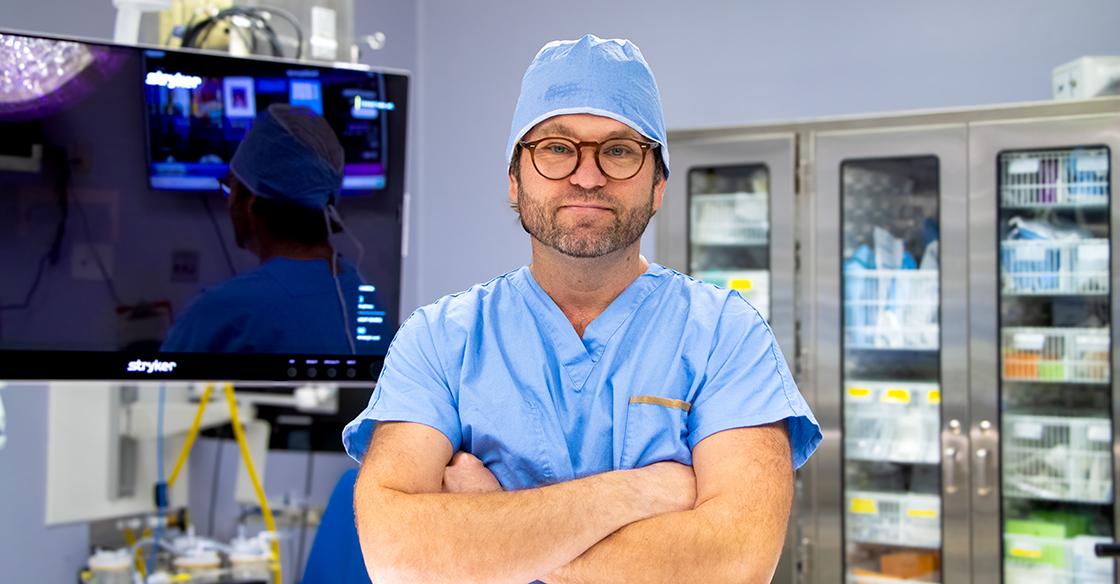
Pictured: Internationally educated and specializing in minimally invasive surgery and surgical oncology, the QEII's Dr. Rich Spence will first use the soon-to-be donor-funded da Vinci Xi in rolling out robot-assisted colorectal cancer surgeries for QEII patients.
Clearer optics. Ergonomic improvements. Computer assistance. Digital storage for video training and research. These are just some key highlights that Dr. Rich Spence, QEII General Surgeon and Assistant Professor in Minimally Invasive Surgery and Surgical Oncology, Division of General Surgery at Dalhousie University, awaits as the QEII Health Sciences Centre prepares for its newest surgical robot.
The da Vinci Xi is a groundbreaking surgical tool used in minimally invasive surgeries to treat certain cancers. And since Dr. Spence specializes in minimally invasive surgery and surgical oncology, he’s looking forward to how this incredible new technology can be integrated into the operating room.
Dr. Spence focuses on colorectal, gastric, adrenal, and small-bowel cancers, as well as bariatric and hernia surgery.
The new surgical robot, which will be funded by QEII Foundation donors as a part of the QEII’s Centre of Excellence in Robotic Surgery, will directly affect Dr. Spence’s work as the da Vinci Xi will soon be used at the forefront of minimally invasive colorectal surgeries at the QEII.
Expanding access to elevated care
Until this point, Dr. Spence didn’t have access to the QEII’s current da Vinci X robot, used for treating certain cancers with incredible precision. It’s heavily relied upon by QEII surgical teams, running five days a week, ten hours a day to help treat kidney, gynaecological, and ear nose and throat cancers.
The addition of the da Vinci Xi will mean that robotic surgery at the QEII can now expand to other surgical areas, including colorectal cancer, more gynaecological and reproductive cancers, thoracic cancers and beyond.
He’s looking forward to the many benefits that surgical robotics can bring for certain patients, like increased precision allowing for smaller incisions.
“The more minimally invasive you can be, as long as you're not compromising oncological outcomes, the better overall outcomes for patient,” he says.
“Their stay is shorter in hospital. There’s less pain. Better cosmetics. And less morbidity related to the surgery itself.”
These are all potential advantages that QEII Foundation donors will help enable.
Dr. Spence also highlights a unique benefit surgical robotics brings to Nova Scotia – the ability to perform more precise surgeries on obese patients.
“Particularly in the province of Nova Scotia, which does have a very high incidence of morbid obesity, your advantage within minimally invasive surgery is exponentially higher with patients who have higher body mass index,” he says.
One of the biggest challenges with pelvic cancers, like colorectal cancer, Dr. Spence explains, is access. The da Vinci Xi will empower surgeons to reach delicate areas with enhanced precision in patients with a higher BMI, or in male patients with a smaller pelvis.
Surgery is even more difficult with advanced cancers, as the surgeon must approach tumours more aggressively to safely remove all the affected tissue.
“The dexterity, visibility and ergonomics that the da Vinci Xi brings will really enable us to be both more minimally invasive and aggressive.”
Attracting talent with surgical precision
For Dr. Spence, these types of innovative advancements in surgery are just what he’s been preparing for and eager to see.
Originally trained in medicine in South Africa, Dr. Spence first focused on general surgery but travelled to expand his skillset:
“Back in South Africa, we do a lot of open surgery, a lot of acute trauma surgery, less cancer surgery, and less minimally invasive surgery.”
“The plan was to come to a more developed environment and upskill specifically minimally invasive surgery.”
Dr. Spence completed some academic training in the US and the UK and then came to Nova Scotia to complete a fellowship in minimally invasive surgery under several QEII surgeons. After then training in surgical oncology in Toronto, he returned to Nova Scotia in 2021 to join the QEII Health Sciences Centre following the passing of his former QEII mentor, Dr. Dennis Klassen, from pancreatic cancer.
“It was a full circle,” he reflects.
Today, he builds his life with his family in South End Halifax and calls Nova Scotia one of the best places in the world for its “beauty, the people, the space, and the fact that it's so safe…a great place to raise kids.”
Dr. Spence thinks that the addition of the da Vinci Xi will attract even more surgeons like him, expanding the diverse talent available at the QEII.
“What drew me to Nova Scotia in the first place was the fellowship in minimally invasive surgery,” he says.
“We’re now hoping to bring an even bigger influence on the surgical oncology space within that fellowship and can also now bring trainees on for robotic training to keep us competitive with some of the best fellowships in North America and globally.”
Empowering, not replacing
As surgical robotics evolve to take more of the center stage at the QEII and across the globe, Dr. Spence acknowledges that patients sometimes worry about automation or artificial intelligence “replacing surgeons.”
He explains that the term “robotic surgery” can be a bit confusing:
“[Surgical robotics] are still at this stage entirely controlled by the surgical team. So, there's nothing automated about it. It does nothing independently without your control.”
In fact, the robotic platform adds layers of personalization and safety through intelligent design and checks built into the system.
Take stapling – a critical step when dividing tissue during cancer surgery. With traditional handheld staplers, success relies on surgeon judgment, which is still a safe and effective approach to surgery. But the use of robotic technology elevates the process a bit further.
With the addition of surgical robotics, tissue thickness is digitally analyzed, since it can differ due to individual anatomy. Then, the robot confirms which stapler is appropriate for that specific patient’s tissue. Traditionally, surgical staplers are colour-coded per organ, but with tissue analysis, robotics can reveal a different approach for a more personalized surgical experience.
The robot then asks for surgeon verification before firing a staple and requires multiple confirmations to do so.
Dr. Spence explains that robotic technology has many brilliant minds behind these innovative features: “There’s a lot of checks and balances that you have a whole engineering team behind.”
What’s next for surgical robotics?
Dr. Spence looks forward to what surgical robots may unlock for the future of surgical care at the QEII and across the globe.
In addition to decreased pain, fewer side-effects and faster healing times, some amazing potential benefits of the da Vinci Xi can include secure video storage and remote proctoring for learning and research, clearer optics for a better view, and refined ergonomics for improved surgical access.
In the future, Dr. Spence imagines that surgeons around the world may use surgical robotics technology to perform surgeries remotely from a console connected to the robot from anywhere in the world – something he believes will advance surgical equity in Canada and across the globe.
He also believes in the potential of AI and machine learning, thinking that it may play a more active role in advising surgical care teams:
“There may be options or suggestions for more standardized, safe, efficient clinical care. I don’t think we’ve reached that potential yet.”
Powered by our community
As surgical teams are preparing to dive in with the new da Vinci Xi and its future impacts for their care areas, Dr. Spence is moved that our local QEII Foundation donor community is rallying to fund it, helping elevate cancer care in Nova Scotia.
“People entrust us to take the field of medicine and surgical applications in an area where it should go. And we feel very strongly that this will be money well spent,” Dr. Spence says.
“We feel very well supported.”
He sees this kind of incredible philanthropy a part of what makes Canadian – and Nova Scotian – health care so special.
“That sense of community in a healthcare space is very apparent. There’s this philanthropic drive to contribute resources to the common good. It’s phenomenal.”
Help fund the QEII’s next surgical robot. All donations to the QEII’s Centre of Excellence in Robotic Surgery will be DOUBLED by the Davison family, up to $100,000, until December 31, 2025. Donate now.
The upcoming implementation of the QEII’s da Vinci Xi is a team effort across the QEII Health Sciences Centre. Additional key practitioners involved include Head of Department of Surgery at Dalhousie University and Nova Scotia Health (CZ) Dr. Gail Darling, QEII colorectal cancer surgeon Dr. Katerina Neumann, hepato-biliary-pancreatic service chief to the QEII surgical department Dr. Boris Gala-Lopez, QEII thoracic surgeons Dr. Alexander Ednie and Dr. Alison Wallace, QEII division head of gynaecologic oncology Dr. Stephanie Scott, and more.