

Robotic surgery isn’t a futuristic idea anymore — it’s now a beloved option by surgeons in the operating rooms at the QEII Health Sciences Centre, thanks to innovative-minded donors of the QEII Foundation.
Now there is an opportunity to tap into the next generation of surgical robotics technology with the da Vinci Xi. This robot will continue to help those needing procedures to help fight a variety of cancers while allowing healthcare teams to treat more patients with even greater precision, across more specialties.
QEII Foundation donors made Atlantic Canada’s first surgical robot — the da Vinci X — a reality in 2019, enabling life-changing cancer surgeries ever since.
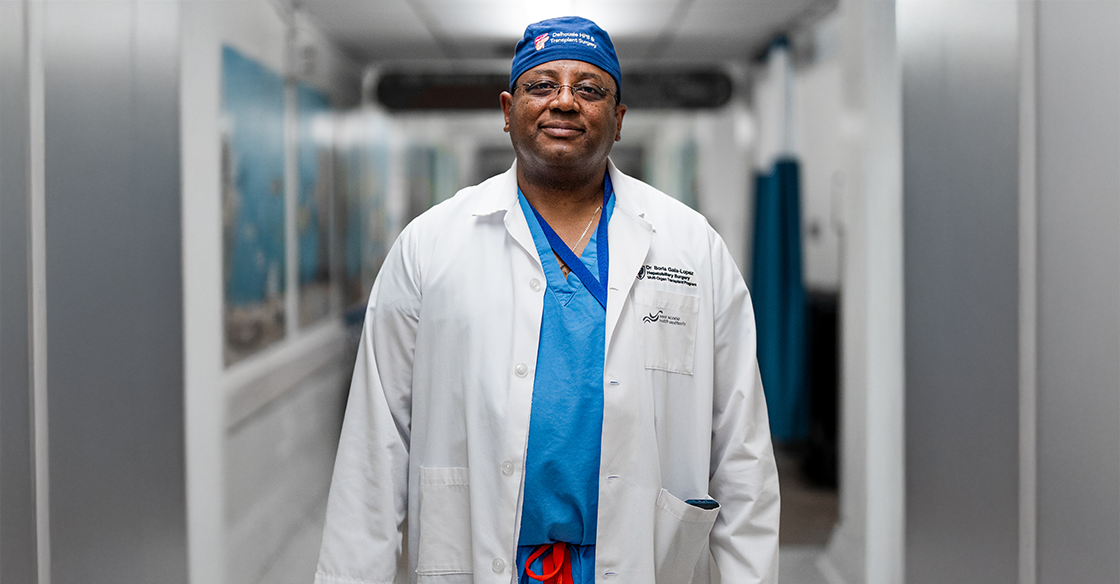
Dr. Boris Gala-Lopez, hepato-biliary-pancreatic service chief to the surgical department at the QEII Health Sciences Centre, completed Nova Scotia’s first-ever robotic surgery on a patient with pancreatic cancer on the da Vinci X in the spring of 2025. He is also scheduled to be one of the first to use the da Vinci Xi— needless to say his excitement is palpable.
In this Q&A, Dr. Gala-Lopez shares how surgical robotics is changing the future of care for patients and families across Atlantic Canada.
Q: What makes you excited about soon working with the da Vinci Xi surgical robot at the QEII?
Dr. Gala-Lopez: It’s going to make a significant difference. It’s a new generation of surgical robotic technology with a lot of ergonomics in mind and safety for patients. We’ve been working to bring a da Vinci Xi to the QEII for a long time — it will be exciting to have patients in Nova Scotia and beyond be able to access it. It’s a dream to have it, even from a research perspective!
Q: Since you mentioned it, how will local researchers benefit from the da Vinci Xi?
Dr. Gala-Lopez: It allows for a lot of data to be produced. We can use the information for quality improvements on the way we provide care, but also for training surgeons, residents, and fellows. The da Vinci Xi has a significant amount of data that is generated in every procedure. It also tracks the number of instruments you use, how many times you use the instrument and how efficient your movements were. It will also correlate what happened in the OR to the outcome of the patient — who had a complication, whether the patient went home sooner or if the patient came back to the emergency department. We need to know what kind of impact it has on our health structure.
Q: You mentioned training. How do you prepare for a new surgical robot to join the team?
Dr. Gala-Lopez: The da Vinci brand of surgical robots has been around for a while, so there is a clear pathway to become certified on it. You start by completing online training and then move to simulation training — using 3D virtual models. This allows you to get familiar with the console, the controls, the pedals and the vision you will have. Then you have a day or two of what is called “wet lab” training, which I completed in Texas, as there are currently none in Canada. This is something we are really fighting to have included in the QEII’s Centre of Excellence in Robotic Surgery — it would be a fantastic opportunity for us in Nova Scotia, and for all Canadian surgeons. From this point, you observe a case performed by a surgeon in your specialty using the robot. They observe you completing a case and then you are good to go.
Q: What difference will the da Vinci Xi make in the patient experience?
Dr. Gala-Lopez: It will be a significant benefit and advantage for our patients at the QEII. We are going to be able to do cases laparoscopically because of the delicacy of operation, we didn’t have the right tools on hand. We will be able to perform very complex surgeries in any specialty and to be able to do it in a minimally invasive way, which can mean leading to quicker recovery times.
The da Vinci Xi will benefit cancer patients as they can often heal faster from surgery to be able to start any follow-up treatments (such as chemotherapy) faster. Another benefit will be just being able to do more minimally invasive surgeries — patients usually don’t have as much pain with these types of surgeries, which means they may need less pain medication in and out of hospital. So, it’s a way to minimize opioid use as well. Plus, the ability to move around and be discharged home quicker — there are lots of benefits! It’s good to keep the patient in the centre of our plans, even as we are very enthusiastic about getting this technology.
Q: Do you expect the da Vinci Xi robot to help with physician recruitment to the QEII?
Dr. Gala-Lopez: I believe so. There is a significant drive in both older and newer generations of surgeons to embrace surgical robots. Recruitment is key for the future development and growth of our program. We want to make sure we recruit and retain the best people for the population here in Nova Scotia. We have an HPB surgeon set to retire, so earlier in 2025, we started the recruitment process of looking for someone fully trained in robotic surgery — to help grow the program for years to come. And we were successful because we had a plan to get the technology here.
Q: What would you say to our QEII Foundation donors and those considering a gift to support the da Vinci Xi and the Centre of Excellence in Robotics?
Dr. Gala-Lopez: These are exciting times. It is comforting to see Nova Scotia taking the lead in Canada in such a high impact technology in health care. This will empower Nova Scotia to be even greater and will basically allow patients to get the care they need here promptly, hopefully. You are investing in the future when you donate — I’m also a donor of the QEII Foundation. It's a no-brainer for me. Giving to support the da Vinci Xi robot is an opportunity where people can directly contribute to their own welfare — they can have their care at the same grade-A level and standard as anywhere but done here locally at the QEII.
Discover more about the da Vinci Xi robot and the QEII Foundation's Centre of Excellence in Robotic Surgery project, or donate now: https://my.qe2foundation.ca/donations-coe-robot