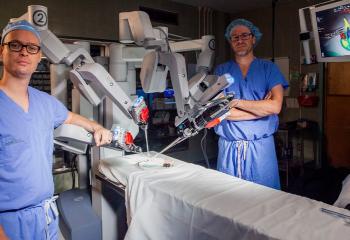


Donors to the QEII Foundation are working hard to make funding an item on the QEII Health Sciences Centre surgical team’s wish list a reality.
The da Vinci Xi is the next generation of surgical robotics technology, which will help those needing procedures to help fight a variety of cancers. It will also allow healthcare teams to treat patients with even greater precision.
In 2019, QEII Foundation donors brought the first surgical robot to Atlantic Canada and the QEII — the da Vinci X — making life-changing cancer surgeries possible ever since.
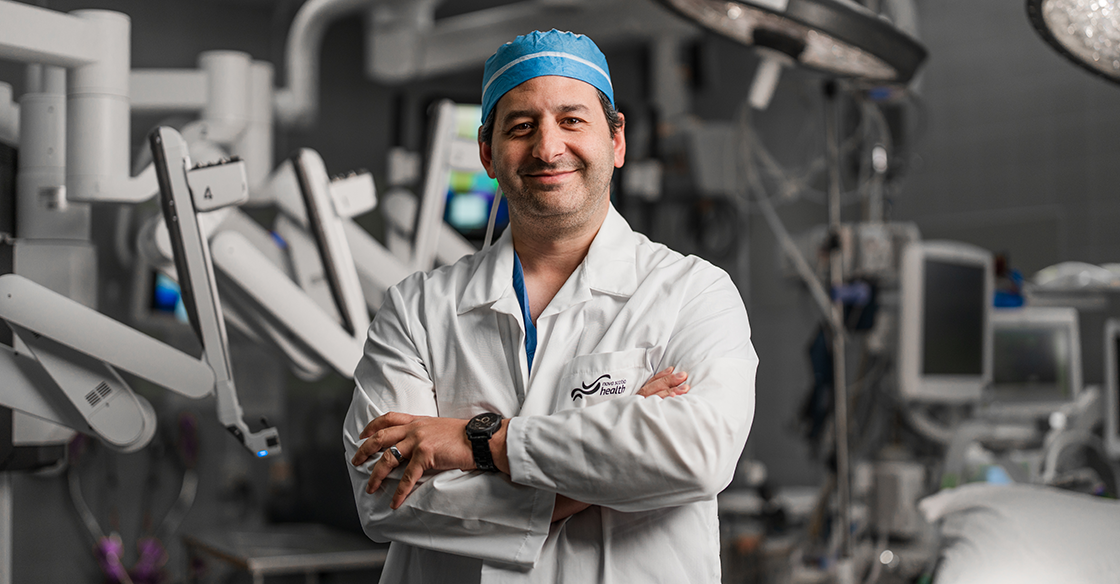
Dr. Ayham Al Afif is a surgeon at the QEII Health Sciences Centre who focuses on head and neck cancer procedures. The QEII is the number one referral centre for advanced head and neck cancers for all of Nova Scotia and PEI plus the very advanced cancers from New Brunswick.
In this Q&A, Dr. Al Afif shares his vision for caring for patients throughout the Maritimes with the assistance of the da Vinci Xi as cases of oral cancers are on the rise.
Q: Can you explain how the da Vinci Xi will help with the kind of intricacies that must come with head and neck surgeries?
Dr. Al Afif: Robotic surgery has really helped revolutionize the way we treat cancers in the throat and the pharynx specifically. The two most common areas we treat with that are the tonsil and the back of the tongue. Traditionally, before trans-oral surgery happened, those tumors would be treated with very morbid procedures that may involve accessing them through the neck or splitting facial bones. But having a surgical robot will allow us to use a camera and smaller instruments that can maneuver around these things that are in the way, like the jaw. It reduces operative time and can allow us to access these tumors without having to do very extensive approaches through the neck or jaw.
Q: In your opinion, what makes the da Vinci Xi such a great tool to have in the operating room?
Dr. Al Afif: The camera for the da Vinci Xi is excellent. It gives you a good view around corners that otherwise you can't see. The instruments for it are very precise so you can work in areas that are otherwise very difficult to access with a good view.
Q: As this technology is going to be new to Nova Scotia, what will having access to this surgical robot mean for patients?
Dr. Al Afif: For patients with head and neck cancer who are suitable for treatment with the da Vinci Xi robot, the less-invasive access we will have to these tumors can make the healing time faster. It allows us to treat patients in more of an individual way based on their tumor and their access. Minimally invasive surgery is better (if possible) for patients in terms of going home sooner, resuming eating sooner and moving on to other treatments if they need it after surgery a lot sooner.
Q: When we talk about going home sooner, will it be the same day? Or do head and neck patients need a bit more time?
Dr. Al Afif: Usually it's not the same day. Without the da Vinci Xi patients may have to stay three or four days in hospital post-surgery. This new robot will probably shorten that post-surgery hospital stay to two to three days. It's because we have to make sure that they're eating and drinking well after the surgery. That there are no complications from the operation. Bigger operations usually equate to a longer hospital stay.
Q: What makes a patient suitable or not to be treated by the da Vinci Xi?
Dr. Al Afif: Patients may be suitable if they have smaller tumors in their tonsil or the back of their tongue — where taking it out through the mouth is possible, without creating too big of a defect that would require formal reconstructive surgery. Those would be the ideal patients for this procedure on the da Vinci Xi.
Q: What does it mean for you as a practicing surgeon to soon have the da Vinci Xi accessible to your team?
Dr. Al Afif: It is very exciting because it allows us to offer these operations to patients, which allows us to have more care options to offer them. If they have cancers in their tonsil, the back of the tongue, or the rest of the throat, it’s really going to revolutionize how these surgeries will be performed. It's great for patients in Nova Scotia to have access to.
Q: When or if donors are considering making a donation to the da Vinci Xi and the Centre of Excellence in Robotic Surgery at the QEII, what would you say to them?
Dr. Al Afif: I would say thank you. The da Vinci Xi is going to put us at the QEII at the forefront in Canada when it comes to head and neck surgeries — we would be amongst a handful of centres that use it. For those who are candidates for surgical robotics, it would give us more tools to treat our patients, to give them less invasive surgeries where they can function significantly better afterwards, healing faster and getting back to their lives faster. Your donations are invaluable to robotic surgery and making our centre the Centre of Excellence not only in the Maritimes but across Canada.
Q: Speaking of the Centre of Excellence in Robotic Surgery, how important or exciting is that concept and being the first one in Canada?
Dr. Al Afif: It is a unique opportunity because not only does it allow us to really be at the forefront of providing robotic treatments for patients, but it also puts us at the forefront for making and/or advancing cutting edge treatments and research, which is rapidly expanding. It is exciting for surgeons and patients. A Centre of Excellence doesn’t only mean we will deliver excellent care; it will mean we can teach it, spread the knowledge to other centres and be at the forefront of research endeavors as far as robotic surgery.
Q: How important is the da Vinci Xi when considering the recruitment and even retention of medical professionals to the QEII?
Dr. Al Afif: It's very important. Internationally, most centres have access to surgical robots — some with the da Vinci Xi. It's very important for us to be at this forefront, especially for head and neck cancers. Cancers of the tonsil and the tongue base are on the rise exponentially, and they're becoming far more prevalent in younger people. As the volume of these cancers goes up, we need to have the tools to support our work. In the right patient, the da Vinci Xi may help them avoid additional therapy, like radiation and chemotherapy, afterwards. So having this robot will be paramount for patients and the QEII, as a leading institution in surgery throughout Canada and especially the Maritimes.
Discover more about the da Vinci Xi robot and the QEII Foundation's Centre of Excellence in Robotic Surgery project, or donate now: https://my.qe2foundation.ca/donations-coe-robot