

Select heart health patients can now receive a minimally-invasive mitral valve repair — a donor-supported breakthrough made possible at the QEII Health Sciences Centre this fall. Instead of cutting through the breastbone, surgeons make a few small incisions between the ribs, inserting a 3D camera and long, delicate instruments to repair the valve with remarkable precision. The result? For some patients, it can mean less pain, less trauma, shorter hospital stays, and a return to daily life weeks — not months — sooner.
This milestone marks the launch of the QEII’s new minimally-invasive cardiac surgery (MICS) program, a field transforming heart healthcare worldwide. Thanks to early QEII Foundation donor support — contributing toward the $450,000 needed to bring this program to life — cardiac surgeon Dr. Roberto Ribeiro and the QEII team have already completed six successful cases. And they’re just getting started.
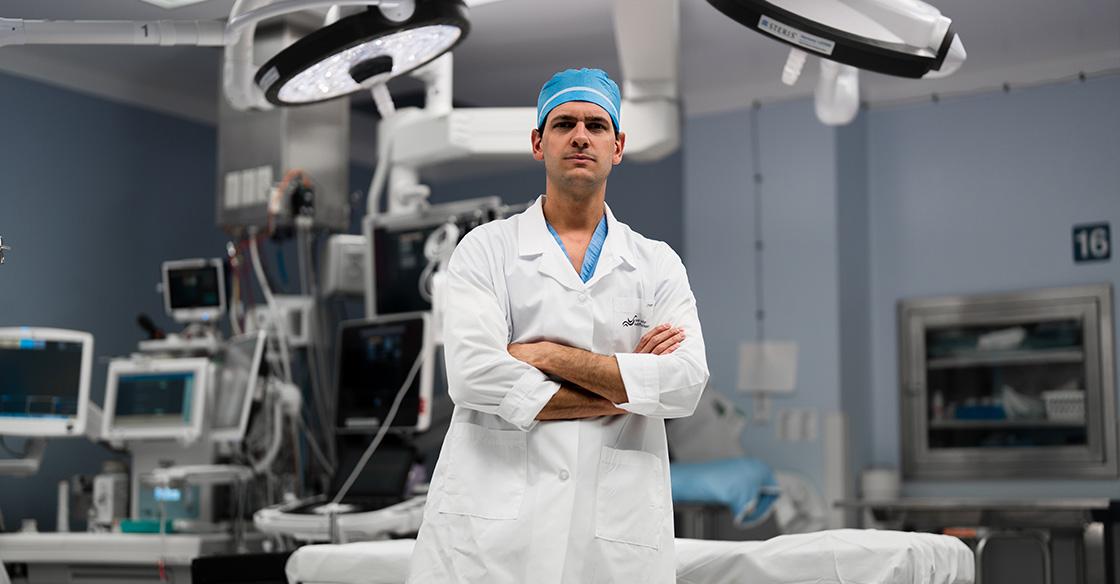
Recruited back to the QEII in August 2025 following advanced fellowship training in the Netherlands, Dr. Ribeiro is leading the charge to expand this program even further. From training additional surgeons and healthcare teams, to tackling more complex cardiac procedures, to laying the foundation for future robot-assisted heart surgeries, his vision is bold and now, finally, within reach.
In the following Q&A, Dr. Ribeiro shares his journey, the impact of this milestone, and what this means for the future of cardiac care in Atlantic Canada.
Q: You recently returned to the QEII to launch Nova Scotia’s minimally-invasive cardiac surgery program. Can you share a bit about your background and training?
A: Most of my cardiac surgery training was here, at the QEII. I was born in Brazil, raised in Toronto until I was seven, then moved back to Brazil where I completed my medical education and general surgery training. I eventually came back to Canada, did my PhD in Toronto, started cardiac surgery there, and transferred here because my wife is an ophthalmologist at the QEII. After completing most of my training in Halifax, I then went to the Netherlands for a year-long fellowship in advanced mitral valve and minimally invasive cardiac surgery. Now, I’m back at the QEII as of this August.
Q: What makes this new MICS program so important for patients and for cardiac surgery as a specialty?
A: Minimally-invasive surgery is a growing field across all specialties. It’s often becoming the standard of care, as long as we can ensure safety. Globally, we’ve shown that minimally-invasive cardiac surgery can deliver the same outcomes and durability as traditional open-heart surgery, with better recovery.
With our first cases here, we’ve shown we can do them safely and with positive patient outcomes. Now it’s about growing our numbers so every eligible mitral valve patient can be considered for this approach.
Q: Tell us about these minimally-invasive mitral valve repair procedures performed this fall. What type of patients have been benefiting from these procedures?
A: We’ve launched the program successfully, which is incredibly exciting. Six cases performed so far and the results have been excellent. One of our initial patients is an avid biker and at one of his post-procedure appointments, he asked when he could start cycling again. I told him, ‘if you had asked me earlier, I would’ve told you to get back on your bike the first day you got home.’ That’s arguably one of the biggest advantages of these minimally-invasive surgeries: faster recoveries.
In terms of who we’re treating this way? Right now, we’re choosing lower risk patients for this minimally-invasive approach as we continue to build and establish the program. This way of surgery is more complex and technically challenging as well as takes longer in the OR, so for safety, we select patients with good heart function, “simple” mitral valve pathology, and appropriate body habitus; they’re not too small or not too big.
But that’s just our starting point. Where I trained in the Netherlands, anyone could be considered for minimally-invasive mitral surgery. With the experience we’re gaining here, we’re progressing fast — soon we’ll be able to expand those criteria.
Q: What are the biggest benefits of minimally-invasive cardiac surgery?
A: No question, it’s the recovery. We’ve seen hospital stays of three to five days instead of seven to ten compared to traditional open-heart surgery. Patients are back to living their lives sooner. It can make a huge difference in their quality of life immediately post-procedure.
Q: Can you walk us through what the minimally-invasive procedure actually looks like in the OR?
A: We do these repairs in a regular operating room. Our typical incision is roughly three centimetres — compared to a 20–25 centimetre cut when you open the breastbone. We use a 3D camera with special goggles, 2D and 3D screens, and long, specialized instruments. Many of these tools are generously funded by donors.
Q: How important is MICS for recruiting and training the next generation of cardiac surgeons?
A: Absolutely essential. Trainees now expect exposure to minimally-invasive techniques — it’s a must. Having a program like this helps attract and retain top talent and keeps the QEII competitive in advanced cardiac care.
Q: Other centres in Canada are beginning to perform robot-assisted cardiac surgeries — like Toronto’s St. Michael’s Hospital earlier this year. How does that influence where the QEII could be headed?
A: Our current MICS program is a great, first step towards adopting robot-assisted cardiac surgery in the future. There’s a surgical robotics system that’s currently approved for cardiac procedures in North America, and more centres across the country are starting to use it.
It’s exciting because robotics automatically collects data for every case. It then allows us to use that data efficiently and effectively.
I think the ultimate goal, clinically, for our MICS program is to build onto surgical robotics and integrate heart health as part of the Centre of Excellence in Robotic Surgery. The QEII Foundation and its donors are a big part of that vision, already funding robots for cancer care, spinal, neurosurgery, orthopaedics, general surgery and more. I’d love to one day see our cardiac surgery team utilize advanced robotics technology to take these minimally-invasive programs even further.
Q: What’s your long-term vision for minimally-invasive and robotic cardiac surgery at the QEII?
A: We want to expand to all types of mitral valve disease and we will soon be adding procedures like atrial fibrillation surgery, tricuspid valve repair, aortic valve surgery, and minimally-invasive coronary bypass. Here at the QEII, we have the volume to make minimally-invasive mitral valve repairs standard of care.
That’s the ultimate vision: a full, comprehensive minimally-invasive cardiac surgery program, with the potential of robotics in the future. Donor support is a huge part of making this possible.
The QEII Foundation is actively raising funds in support of Nova Scotia’s minimally invasive cardiac surgery (MICS) program; a $450,000 project and fundraising goal that’s part of the QEII Foundation’s $100-million We Are campaign.
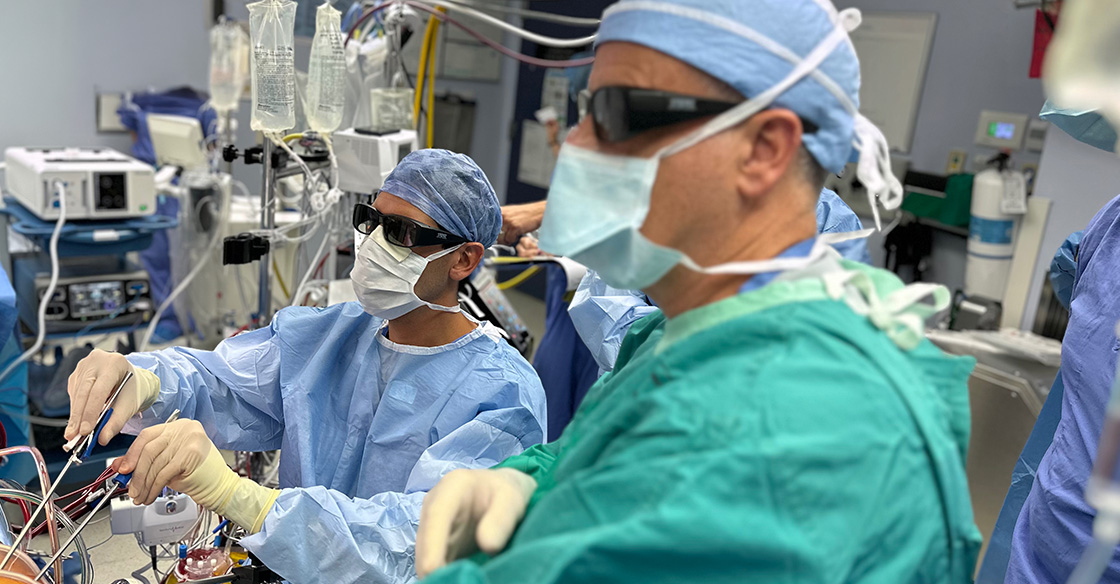
Pictured: One of the first minimally-invasive mitral valve repair procedures performed by Dr. Ribeiro at the QEII this fall.