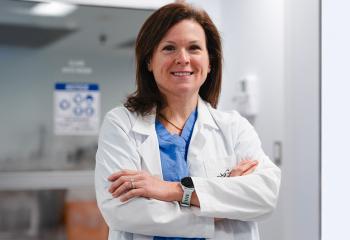


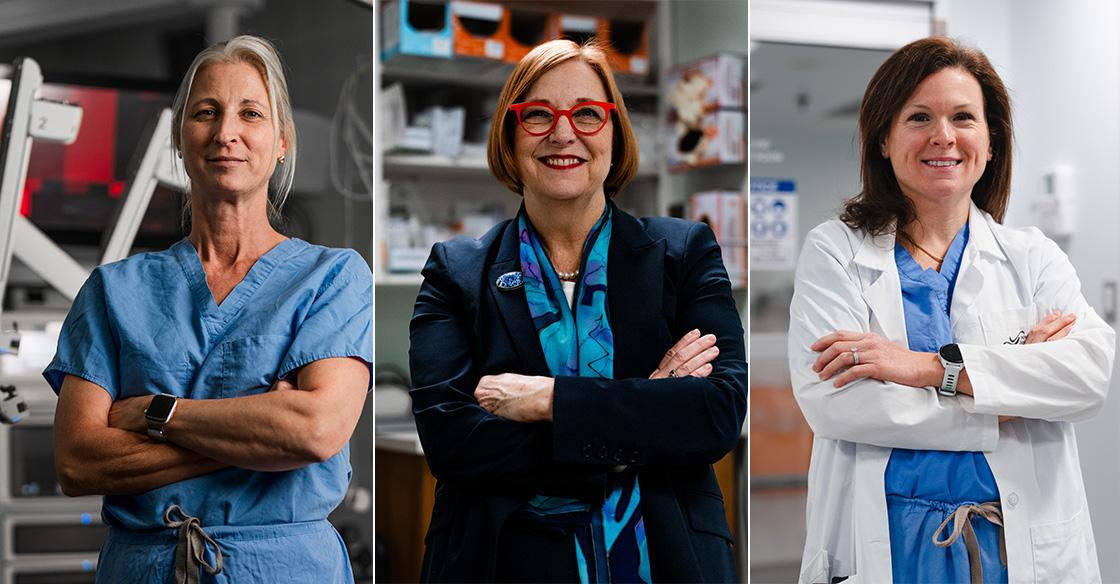
Article originally published via The Globe and Mail. Pictured (L-R): Dr. Katerina Neumann, Dr. Gail Darling, and Dr. Stephanie Scott.
At the QEII Health Sciences Centre in Halifax, colorectal cancer surgeon Dr. Katerina Neumann is eager to get her hands on a ground-breaking surgical robot that donors will help make possible for the Atlantic region’s largest adult hospital.
In 2019, QEII Foundation donors made history by bringing Atlantic Canada its first surgical robot, the da Vinci X, for cancer surgeries. Since then, more than 1,600 robot-assisted procedures have been performed using the technology at the QEII. Its success created an urgent need for a second robot – the da Vinci Xi – which will help surgical teams treat more patients in more care areas, with even greater precision.
“We are so excited to utilize this technology and to expand opportunities to be on the cutting-edge of innovation and research in the robotics field,” Dr. Neumann says.
Canada’s first Centre of Excellence in Robotic Surgery is anchored at the QEII, where surgical innovation meets research, real-time data, artificial intelligence and advanced training. It will be funded by donors to the QEII Foundation, with a $20‑million campaign underway to further support the centre’s technology and equipment.
Dr. Gail Darling leads the department of surgery at Dalhousie University and for Nova Scotia Health Central Zone, which includes the QEII Health Sciences Centre. Since taking the role in 2022, she’s worked to align surgeons, researchers and trainees behind a common goal: building the QEII’s Centre of Excellence in Robotic Surgery and expanding access to advanced surgical robots.
“I came to realize that surgical robots are a game changer, and I came to appreciate that the technology will bring us added value. It wasn’t just a gimmick or marketing tool. It will, as I always say, up everyone’s game,” she says. “It will allow us to do complex, minimally invasive procedures that we can’t do or couldn’t do well using standard, minimally invasive techniques.”
For Dr. Darling, the addition of a second da Vinci robot for QEII teams will be an important milestone, but not the finish line.
“My goal is to acquire a third one next year,” she says, adding that this will expand access to a range of surgeries such as cardiac, liver and pancreas. “Ultimately, we think we will need four da Vinci robots to provide access to all patients who are candidates for robotic surgery at the QEII.”
Surgeons have long performed laparoscopic surgery, a minimally invasive approach performed through small incisions using a camera and specialized instruments. But Dr. Stephanie Scott, division head of gynaecologic oncology at the QEII, says surgical robots allow for even greater precision.
“Robotic instruments articulate and move in a way laparoscopic instruments cannot”, she explains. “This allows for more complex maneuvers in hard-to-reach spaces,” says Dr. Scott.
The robot also makes surgery possible for patients who might otherwise face open abdominal surgery or be unable to undergo surgery at all because of potential complications. “It’s changed who we can offer minimally invasive surgery to,” Dr. Scott says.
She’s been using the QEII’s original da Vinci robot since 2019, performing life-changing robot-assisted surgeries for those facing gynaecological cancers like endometrial cancer. With a new da Vinci robot soon at the helm, Dr. Scott is excited for what’s ahead and for the patients who will ultimately benefit.
Robotic surgery in action
In the operating room, the surgical robot is positioned beside the patient, its four “arms” ready for action. At a nearby console, the surgeon controls the system while viewing a magnified 3-D image from the internal camera. Each arm ends in a wristed joint that mirrors the surgeon’s movements with remarkable dexterity, allowing precise work in the narrow spaces inside the body.
“We are able to achieve more, and all of this comes with exceptional outcomes for patients,” says Dr. Neumann.
“It’s amazing,” says Dr. Scott. “We can offer minimally invasive surgery to people that we couldn’t before.” That means smaller incisions, less disruption to adjacent tissues, less scarring, less blood loss, less risk of infection, a reduction in pain medication, shorter hospital stays and a faster return to normal activities, she adds.
Some surgical patients “are often going home the same day as their surgeries now,” Dr. Scott explains, with many patients saying they can’t believe they just came out of the operating room. “I can say it’s a game changer for them.”
Building the future of surgery
The establishment of the QEII Centre of Excellence in Robotic Surgery and the addition of the new da Vinci Xi robot are more than simple wins for patients. They’re also powerful tools for attracting and retaining top surgical talent in Atlantic Canada. Dr. Scott’s department recently recruited a gynaecologic oncology surgeon from Ontario and another from the United States, and she thinks having access to robotics and the latest da Vinci Xi technology was an important factor in the doctors’ decisions to come aboard.
“Surgeons want to provide the best care with the best tools,” says Dr. Scott, adding that they also want to advance care for future patients through research. “This is an ideal setup for that, and I think it’s had a huge impact on our ability to recruit.”
Dr. Neumann is eager to expand her research through the Centre of Excellence in Robotic Surgery, using its resources to study surgical outcomes across different approaches.
“I’m heavily invested in research that looks at patient outcomes who are being managed for colon and rectal cancer,” she explains, such as cancer outcomes from surgery, how quickly patients regain full bodily functions and their quality of life post-surgery.
“Without the research, information and data, it’s hard for us to counsel patients about what to do, because in today’s world, there’s often more than one choice,” she says.
With the addition of the da Vinci Xi robot, the QEII will be home to seven surgical robots for various care areas; six of which are or soon-will-be funded by QEII Foundation donors.
The QEII Foundation’s work allows all the surgical magic to happen, Dr. Darling says. “We would not be here without our donors. It’s an exciting time for us.”
As a bonus, all donations to the QEII Foundation in support of the Centre of Excellence in Robotic Surgery will be generously matched by the Davison family, up to $100,000 until Dec. 31, 2025.
To learn more or donate to the QEII Foundation in support of its Centre of Excellence in Robotic Surgery project, click here.