

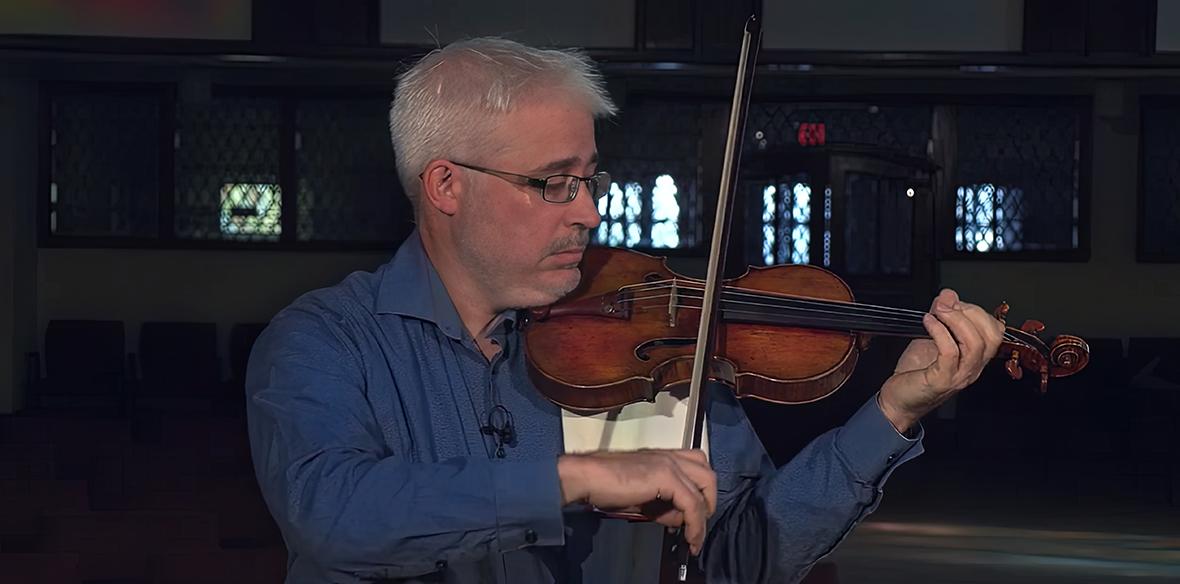
Pictured: Renaud Lapierre, Symphony Nova Scotia musician and Concertmaster.
Renaud Lapierre knows the importance of timing. An accomplished violinist and Concertmaster with Symphony Nova Scotia, he conducts himself with precision and stays calm under pressure.
On November 17, 2025, he saw how each second also counts during a medical crisis while incredible care providers at the QEII Health Sciences Centre worked quickly, calmly, and efficiently to save his life.
That evening, he felt like something was off with his body. His wife urged him to seek immediate medical care and drove him to the QEII’s Charles V. Keating Emergency and Trauma Centre.
“She was proactive,” he says. “I otherwise probably would have died.”
Within minutes of arriving at the QEII, he says that care providers quickly addressed what was a serious medical situation that demanded immediate action.
“They took my temperature, checked my blood pressure, did an EKG, and not ten minutes later the doctor said, ‘Sir, you are experiencing a heart attack,’” Renaud explains.
What could have been overwhelming, Renaud says, was instead an incredibly efficient, organized experience. “The doctors worked smoothly. The care teams were nice. They were good together,” he explains, recalling the rapid, coordinated collaboration that helped preserve his heart in a crisis.
Every second matters
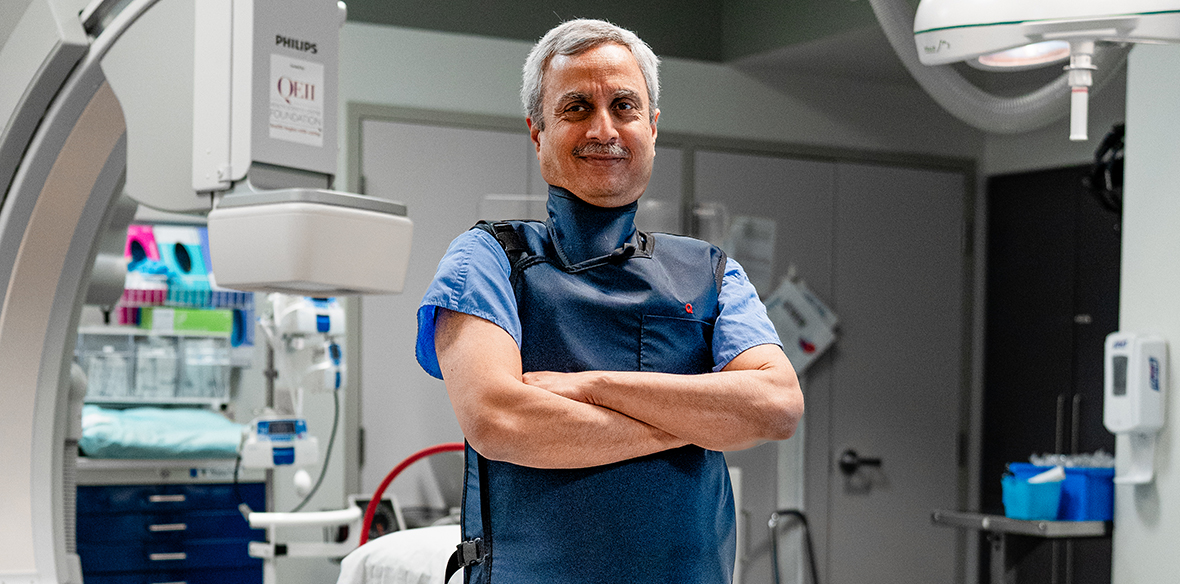
Dr. Ata-ur-Rehman Quraishi, Head of the Division of Cardiology at the QEII, explains that in cardiac care, each moment is critical. The earlier you can treat the heart in a cardiac crisis, the better.
“When someone is having a heart attack, there is a sudden blockage in a coronary artery,” he explains. “The faster you open that artery, the more heart muscle you save. We try to teach patients to call or come early at the first sign of discomfort.”
QEII cardiac care patients, like Renaud, usually arrive by ambulance or directly through the ER. If signs and symptoms point to a specific type of heart attack, they are transferred immediately to a cardiac catheterization lab, often within minutes.
“Our goal is to open their artery within 90 to 120 minutes,” says Dr. Quraishi. “We are in a very short timeline to treat these patients aggressively.”
After he was diagnosed with heart attack, Renaud was rushed to the Joseph Shannon Family Cardiac Catheterization Suite – a space supported by QEII Foundation donors where life-saving procedures happen every day.
Through a small entry point in his right arm, QEII physicians skillfully threaded a tiny catheter to his heart, located the blocked artery, and inserted a small balloon and stent to restore blood flow.
“They popped open the valve that was blocked,” Renaud says. “There was a second one that was pretty badly blocked too.”
He underwent another procedure just two days later to address the second blockage.
Renaud is thankful for the exceptional care he received when every second mattered and is moved by the fact that donor support played a role in his journey through his experience in the Joseph Shannon Family Cardiac Catheterization Suite.
“It’s super nice because the equipment can be expensive. Just being there and seeing it work; it seems to all be very good quality,” he says.
Cardiac crisis to recovery
After a short stay in the QEII’s Coronary Care Unit, Renaud was home within days.
Within the first few days at home, he was walking – slowly at first. By the time the weekend rolled around, he was outpacing his wife on their hikes.
However, post heart attack recovery, Dr. Quraishi explains, doesn’t end when a patient goes home.
“Patients usually stay in the hospital for 72 hours or so, during which time medications are optimized. Then, we let the patient go home. We then send an automatic referral to the cardiac rehabilitation program for every patient who gets admitted with heart attack,” he says.
“Rehab is the cornerstone of prevention.”
Nova Scotia Health’s cardiac rehab program focuses on exercise, nutrition, medication management and risk reduction. Because while the immediate crisis may be over, the work of protecting the patient’s heart continues.
“High blood pressure, diabetes, high cholesterol, smoking – these are the main [risks] we need to address right away. Just taking pills is not enough,” says Dr. Quraishi, explaining that patients must work to monitor and lower their blood pressure and cholesterol levels through a combination of approaches.
Advancing cardiac care through research
After his heart attack, Renaud also enrolled in a clinical trial at the QEII called ARTEMIS, led locally by Dr. Quraishi as the study’s principal investigator in Halifax, Nova Scotia.
“This is a multicenter global study across North America, Europe and Asia. We are proud to be one of the Canadian centres participating,” Dr. Quraishi says.
The study is investigating whether a monthly anti-inflammatory injection with a specialized molecule can reduce the risk of repeat heart attacks in high-risk patients.
“One of the hypotheses of a cause of repeated heart attacks is inflammation in the coronary arteries,” Dr. Quraishi explains.
Participants in the study receive either the active medication or a placebo and are followed closely by the cardiac research team. Results will be received within the next two years.
Dr. Quraishi explains that research is essential to advance care – and patients are essential to research: “We approach a lot of patients. We are very grateful to the patients who participate in our studies.”
Investing in cardiac care research is important across Canada, and is just as important here in Nova Scotia, Dr. Quraishi explains, especially as we face an increasing aging population and welcome people from diverse backgrounds.
“Age itself is a risk factor for heart disease,” he says. “Nova Scotia also has a young immigrant population. We are seeing some people who are coming from different backgrounds that have a higher risk of diabetes and heart attacks at a younger age.”
Dr. Quraishi is quick to credit QEII Foundation donors for help making local research and advancements in cardiac care possible. Through initiatives like the Maritime Heart Centre Innovation Fund, donor support provides grants to heart health researchers and physicians here in Atlantic Canada.
“Donations go a long way for us in terms of improving care for patients across Nova Scotia,” he says.
“We are the only tertiary cardiac care centre and the only transplant centre in Nova Scotia, so we take patients from every corner of the province.”
“The QEII Foundation and its donors have helped a lot in terms of advancing research, procuring equipment and enhancing care for our patients.”
Time to reflect
Today, for Renaud, the show goes on – supported by expert care received at the QEII, donor generosity, and kept in time by the steady beat of a grateful heart.
After his heart attack, he took two months away from work, as recommended. He’s now back at Symphony Nova Scotia, easing into his routine.
“I’m a bit more tired at the end of the day,” he admits. “But it’s pretty much nothing I would say, compared to that day.”
Outside of work, Renaud is enjoying precious moments, like playing music together with his wife, hiking together with their dog near their Kearny Lake home, and playing board games. He remains grateful for the kind and compassionate QEII care teams who stayed calm and capable during a moment of crisis.
“As strange as it sounds, I really enjoyed the care because it was just filled with such a nice spirit,” Renaud says. “It was a great experience.”
P.S. With donor support, we are striving towards cardiac care innovation at the QEII with a new minimally invasive cardiac surgery (MICS) program, transforming outcomes for patients. Learn more at QE2Foundation.ca/MICS