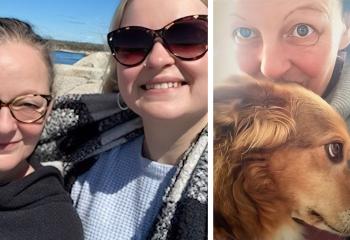


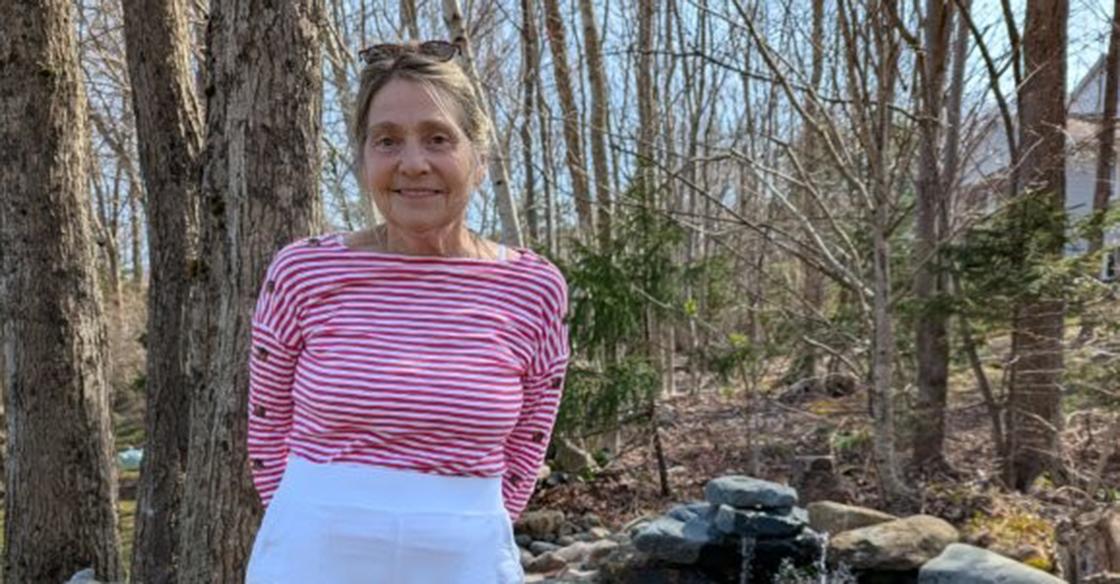
Pictured: Cheryl Bidgood practices standing straight after receiving scoliosis surgery with the QEII's donor-funded surgical robot for spinal surgeries.
When Cheryl Bidgood looks back on early 2025, she describes feeling as though her life was ‘being squeezed out of me’ by her own spine.
“My rib cage was sitting so low it was basically on top of my hips. My spine had essentially collapsed. I couldn’t breathe. I couldn’t eat. I wasn’t living well.”
Cheryl had been managing scoliosis since childhood, complicated by Charcot–Marie–Tooth disease, a neuromuscular disorder that gradually made everything harder. Walking left her gasping for air.
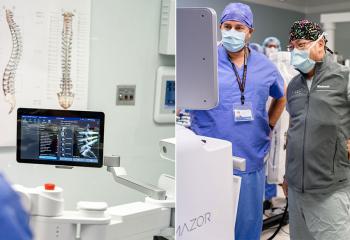
On the day of her surgery, Cheryl was wheeled into a QEII Health Sciences Centre’s operating room —a space she remembers vividly. She had seen many operating rooms since being diagnosed at four years old, but this one was different.
“I remember thinking, ‘I’m not in Kansas anymore,’”, chuckles Cheryl, recalling how massive and sophisticated the OR looked – and how every person there took such great care of her.
Cheryl’s seven-and-a-half-hour surgery was led by orthopaedic surgeon Dr. Andrew Glennie, who combined his expertise with the donor-funded spinal robot to deliver the precision Cheryl desperately needed.
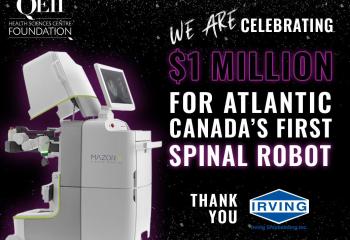
The spinal robot, called MAZOR X, was the first of its kind in Atlantic Canada and the QEII was the first hospital in Canada to perform a patient procedure using the technology.
The $3-million spinal robot was made possible by QEII Foundation donors who funded the technology and its accompanying research.
Robotic‑assisted surgeries like Cheryl’s can offer shorter hospital stays, quicker recovery times, greater precision, and less post‑operative pain. But they are not without risk.
Her care team explained the possible complications—including heart attack, nerve damage, or paralysis—and Cheryl was just as clear in her response: “Whatever you do, whatever is happening to me, don’t stop the surgery. I can’t keep on living like this.”.
Today, Cheryl describes the outcome as nothing short of a miracle. She is walking again. She can eat. She can breathe—fully and freely.
“Breathing is everything. It’s life. I have my life back,” shares Cheryl.
"I cannot overstate the importance of being able to have this life-saving surgery in Halifax at the QEII. I am filled with gratitude to the QEII Foundation donors for having the foresight to fund critical tools like the MAZOR X robot. And so extremely grateful for Dr. Glennie and his team's expertise.”