

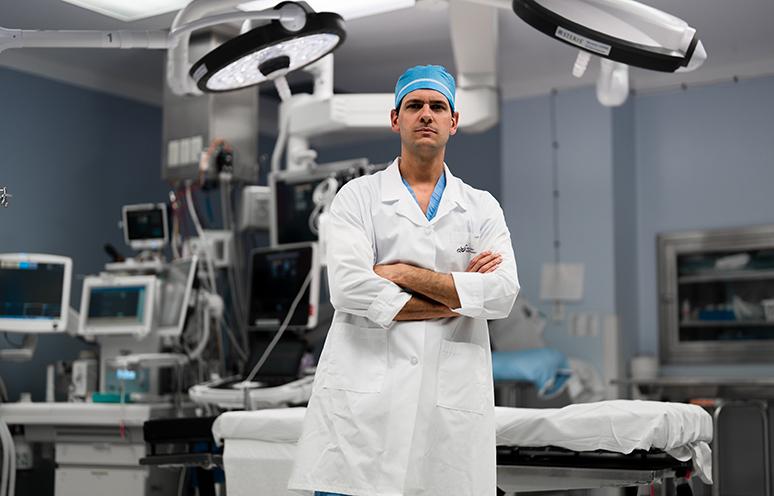
Originally from Brazil, Dr. Roberto Ribeiro moved to Canada to complete his training in cardiac surgery. After advancing his training in the Netherlands, Dr. Ribeiro has returned to Halifax, now offering minimally invasive cardiac surgery at the QEII for Nova Scotians who need it. UNCHARTED.MEDIA
Donor-supported minimally invasive heart surgery a new option for some Nova Scotians
When a heart valve isn’t working properly, life becomes significantly harder, leaving people feeling tired, short of breath and unable to keep up with their daily routines.
One of the most common valves involved is the mitral valve—a small but essential structure that keeps blood flowing in the right direction.
Fixing the mitral valve usually requires open-heart surgery. However, a new option at the QEII Health Sciences Centre offers patients a less invasive option with a quicker recovery.
Some Nova Scotians who need mitral valve repair can now access minimally invasive cardiac surgery (MICS) through the MICS/Endoscopic Cardiac Surgery program at the QEII.
“The first thing to know—and what I tell every patient—is that minimally invasive cardiac surgery or minimally invasive mitral valve surgery is still open-heart surgery," says cardiac surgeon Dr. Roberto Ribeiro.
However, instead of opening the chest through a full sternotomy (splitting the breastbone), surgeons make a small incision between the ribs and use a specialized 3D camera to complete the repair.
Avoiding a sternotomy also means avoiding the lengthy healing period that follows.
“The recovery is a lot faster," says Dr. Ribeiro. "Traditionally, patients who have a sternotomy need about six weeks of what we call 'sternal precautions,' and with this minimally invasive approach from the side through the ribs, there are basically zero restrictions.”
A MEANINGFUL CHANGE
Repairing the mitral valve helps patients regain their quality of life, but until now, the only option in Nova Scotia has been traditional open-heart surgery.
“For many patients, this surgery can mean getting back to their lives sooner and with far less discomfort,” says Dr. Gail Darling, head of the Department of Surgery at Dalhousie University, and the Department of Surgery for Nova Scotia Health Central Zone.
Early patients who have undergone MICS are reporting less pain, less need for narcotics and earlier movement after surgery. Many are returning to everyday activities sooner than expected.
“It’s a full journey of roughly five to seven days in hospital, depending on the procedure," says Dr. Ribeiro.
IN EXPERT HANDS
Originally from Brazil, Dr. Ribeiro moved to Canada to complete his training in cardiac surgery. After completing most of his training here, he travelled to the Netherlands for advanced fellowship training in minimally invasive mitral valve repair.
Returning to Halifax felt like the right next step.
“I trained in Maastricht to learn these techniques at a centre that performs them at the highest level,” says Dr. Ribeiro. “It was fulfilling to come back to where I did most of my training — and to have full support to start this program.”
Dr. Darling has worked closely with Dr. Ribeiro throughout the development of the program. She notes that his mindset is what makes him fit for the job.
“Some trainees aren’t satisfied with the status quo—they want to advance the specialty,” says Dr. Darling. “Dr. Ribeiro is one of those people.”
MADE POSSIBLE BY DONORS
Of course, in addition to expertise, launching a program with the specialized equipment required to perform life-changing surgeries comes at a cost.
The QEII Foundation continues to raise funds in support of Nova Scotia’s first dedicated MICS program; a $450,000 project and fundraising goal that’s part of the QEII Foundation’s $100-million We Are campaign.
Necessary equipment, such as a 3D surgical camera, was made possible by the generous and early support of QEII Foundation donors.
“We needed specific equipment to safely perform this procedure—the camera, retractors, long instruments. Without those tools, it’s impossible to launch a minimally invasive program,” says Dr. Ribeiro. “The QEII Foundation was very helpful in securing what we needed. Having donor support made it possible for us to offer this kind of surgery here in Halifax.”
WHAT SURGERY LOOKS LIKE
On surgery day, patients meet a full care team that provides anesthesia, perfusion, nursing and surgery to discuss safety.
“Number one is safety,” says Dr. Darling. “It doesn’t do us any good to make small incisions if we don’t accomplish the goal.”
A tiny 3D camera guides the procedure.
“One of the best things about having these cameras is that the whole team’s watching,” says Dr. Ribeiro. “Everyone can see what you’re doing, so they know exactly what step you're at.”
After anesthesia is given, surgeons make a small incision between the ribs. The patient is put on a heart-lung machine, operated by the QEII’s skilled cardiac perfusionists, and the heart is safely stopped while the valve is repaired.
Some patients are able to have their breathing tube taken out before they even leave the operating room, with most spending one night in the Intensive Care Unit (ICU) and a total of four to six days in hospital.
MEASURING SUCCESS
During the program’s early phase, the team has tracked multiple indicators, including surgery time, strength and durability of the valve repair, complication rates, blood loss, length of stay, pain control and use of narcotics, mobility milestones, patient satisfaction and long-term valve performance.
According to Dr. Ribeiro, early results are strong, and since the program launched, the team completed six minimally invasive mitral valve repairs by the end of 2025.
“We’re becoming more efficient, and patients are recovering faster,” says Dr. Ribeiro.
LOOKING AHEAD
As the team gains experience, they plan to expand the procedure to more patients and more complex types of mitral disease. In the long term, this work lays the foundation for more advanced surgeries.
“This is about improving outcomes and expanding what we can offer patients,” says Dr. Darling.
“Once we build the experience with minimally invasive mitral valve surgery, we can expand to other minimally invasive procedures,” adds Dr. Ribeiro. “This is the first step.”
Meanwhile, the focus—for now and the future—remains clear.
“At the end of the day, it’s for the patients,” says Dr. Ribeiro. “That’s why we do this.”
Click here to learn more or to support minimally invasive heart surgery.