

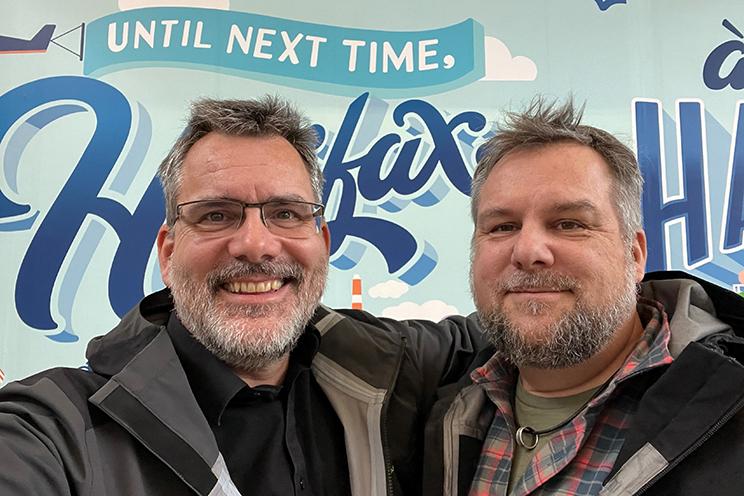
Andreas Fraissl (right) needed emergency gallbladder surgery at the QEII on what was supposed to be his last night in Nova Scotia. This unexpected turn of events meant an extra week recovering before his return trip to Germany with his brother Thomas (left). CONTRIBUTED
Visitor requires emergency surgery at the QEII
In January 2026, Andreas Fraissl was enjoying the last days of a visit to Nova Scotia from Germany. As a child, his parents owned a cottage near Yarmouth and they visited often. As adults, he and his brother Thomas revived the tradition with an annual winter trip to the province.
“It's always amazing and beautiful there,” Andreas says from his home near Heidelberg where he works as a travel agent and tour operator. “We'd been down to the cottage and had a fantastic time. One night, suddenly I had this stomach pain.”
He ignored it and travelled to Halifax to catch a flight home.
The pain returned and ramped up near midnight. Andreas and his brother left the hotel and entered the busy emergency department of the QEII Health Science Centre. When he was seen by a doctor, he learned the problem was his gallbladder.
“They told me, ‘You can't fly back to Germany. It's far too dangerous,’” he recalls.
His brother cancelled their flight to stay by Andreas’s side while he was moved to floor 7.1. Andreas has always been afraid of hospitals, and this emergency entrance into a Canadian one that he had to navigate in a second language was intense.
Laura Brown was working an overtime shift and was tasked with admitting Andreas. She immediately felt empathy for him.
“I just looked at him and said, ‘I'm really sorry that you're in this situation, especially since you’re from out of country.’”
That moment of human honesty connected with Andreas. They talked and she answered his questions as best she could. She told him about her own recent trip to the ED after breaking her leg. By the end of it, they were both laughing.
“She was really exceptional because she was very empathetic. She really had the ability to calm me down,” Andreas says.
She got him extra blankets and pillows. She chatted with him.
After emergency gallbladder surgery, Andreas was soon able to return to a hotel with his brother to recover for a week until he was able to safely fly home. The happy day came, but his insurance told him he needed to get a doctor to fill in a 12-page form granting him permission to fly.
He returned to the hospital where everyone was working full speed. Staff suggested he leave it and return in a few days, but he had blown his travel budget with the prolonged stay and his brother also needed to get back to Germany.
Someone spoke to the doctor. She took her lone break for the day and spent the entire time filling out the complicated form. “Honestly, in Germany, nobody would have done that. The Canadian people, they are just so empathetic and friendly and helpful,” Andreas says.
When he got home to Germany, he had one overriding priority: to thank the nurse who made him feel safe.
When Laura heard a former patient was looking for her, her heart fell. “I thought it was going to be a complaint!” It took her a moment to realize it was praise, and to connect it to the frightened man she’d helped a few weeks earlier. She realized how important it was to add the human elements of transparency and humour to the high-quality medical care to treat the whole patient.
“I'm a real person. They're a real person. Maybe I'm working as a healthcare professional right now, but at the end of the day, we're both just people,” she says. “It's been amazing reinforcement for why I chose this career.”
Ronni Bellefontaine, health services manager, had not worked with Laura often before that overtime shift. “She’s so sweet and such a team player. Laura was elated by the positive feedback. It's just so nice to hear when we make a difference in the lives of patients,” she says.
Andreas has been travelling to Nova Scotia since the early 1990s, but it had always felt like a vacation getaway. After the life-saving stint at the hospital, it feels like home. “I’m part of Nova Scotia now, and it’s permanently a part of me.”
He and Thomas plan to return next year, although hopefully avoiding the hospital adventure.