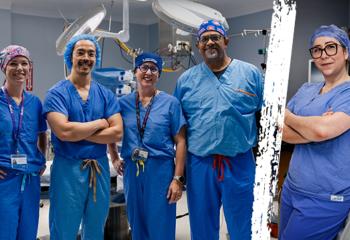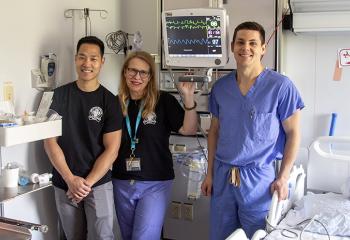


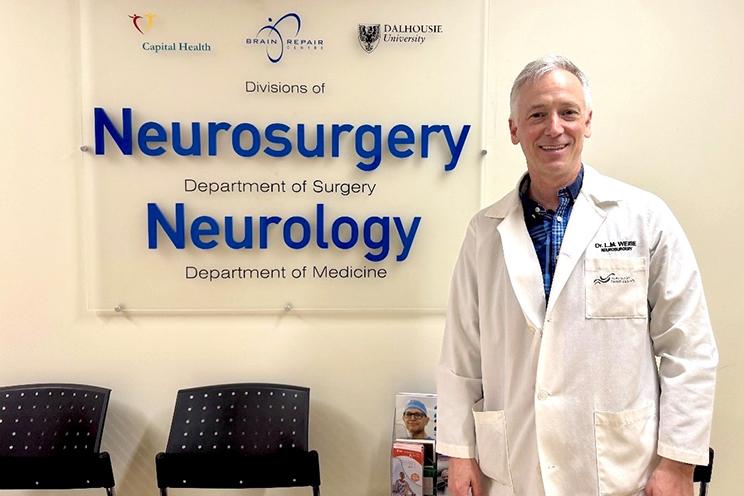
Dr. Lutz Weise, QEII neurosurgeon, says after years of testing, the Leksell Vantage Frame was approved for use in Canada, with the QEII becoming the first Canadian hospital to use it last year. This new surgical device, used in deep brain stimulation, has a metal-free composition that is totally invisible to image scanners. CONTRIBUTED
New surgical device at the QEII improving lives of patients with movement disorders
A new surgical tool at the QEII Health Sciences Centre has helped doctors “stand on the shoulders of giants” to work toward a better life for people with a range of movement disorders.
Dr. Lutz Weise, a neurosurgeon at the QEII, says the Leksell Vantage Frame shows how science and medicine often improve not by leaps and bounds, but by steady advances. Lars Leksell created the first iteration of the device in 1949. It was a metal cage that sat on a patient’s head, holding them in place and letting the surgeon work on exactly the correct spot of the brain. The next major upgrade was the “G-frame” in the 1980s, merging the old device with the advances in digital imaging.
In 2016, Swedish company Elekta created a new version called the Leksell Vantage Frame, with a metal-free composition that is totally invisible to image scanners. After years of testing, it was approved for use in Canada and the QEII became the first Canadian hospital to use it last year.
“I find it fascinating that we're using an instrument that has been developed almost 100 years ago, but now it's all integrated,” Dr. Weise said.
While the G-frame had about 60 pieces that needed to be cleaned and assembled for each surgery, the new Vantage Frame has just 10 pieces and the main head ring is one single piece. That eliminates the risk of assembly errors and speeds up the preparation process. And while the G-frame had a metal bar right across the patient’s face, the new one is totally open at the face. That lets patients feel more comfortable, breathe easier, and better communicate with the surgical team. The new device is also about 30 per cent lighter.
“It’s not a huge new invention, but an important incremental change. It has been already launched in Europe, but we were the first ones to get approved in Canada for it,” Dr. Weise said.
The technology has been used in more than 35 procedures, reflecting both the need for this treatment and the confidence care teams have in the system. Dr. Weise says the new surgical device improves the safety and comfort of patients undergoing deep brain stimulation — a significant treatment for Parkinson’s disease — as well as people treating essential tremor and other movement disorders. It can also be used for people with epilepsy. He says Elekta’s tool helps surgeons perform highly precise brain procedures, supporting safer surgeries, shorter procedure times, and better outcomes.
Deep brain stimulation requires exact targeting within the brain. The Leksell Vantage Frame uses advanced 3D guidance to help surgeons reach those areas with greater accuracy while minimizing impact on surrounding tissue. “Parkinson's patients are the majority of our patients, and Parkinson's-disease patients have a variety of movement or motor symptoms — problems with movements. It can be tremors, shaking, or stiffness. And those three things, we can treat quite well with deep brain stimulation. That usually leads to an improvement of the quality of life for these patients, because that's what's hindering their function throughout the day.”
Levodopa, a medication used to treat Parkinson's disease, works well but patients tend to feel “up or down” throughout the day, depending on how close they are to the last pill. Dr. Weise says that medication can also lead to side effects like dyskinesia, or excessive movements.
“With the stimulation, we can get them more on a stable plateau throughout the day.”
The new device lets them work on the scale of one-tenth of a millimetre, a big improvement over the previous version’s limit of one millimetre. The fewer pieces mean his team can change the coordinates within the “sterile field,” rather than having to redo the entire machine for the second side of the brain.
And before, patients needed to be awake for the entire procedure, as the surgeon needed the patient’s guidance to do the work correctly. Now they can sleep throughout it.
“Patients who are already a bit frail, especially when you do two sides (a bilateral stimulation), it is a marathon that they're going through. It is very lengthy and very strenuous, so reducing the operating room time and being able to do this in a sleep setting is much more comfortable for the patient. With an increased accuracy, we can also reduce the amount of testing we do intraoperatively," he adds.