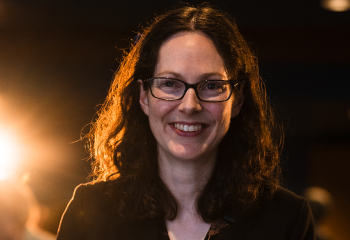


A drive to figure out challenging problems has been at the core of Dr. Abraham Nunes for as long as he can remember. The constant and individualized challenges of mental illnesses inspired him to dive into mental health research, specifically treatment-resistant depression.
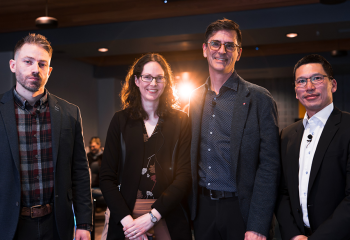
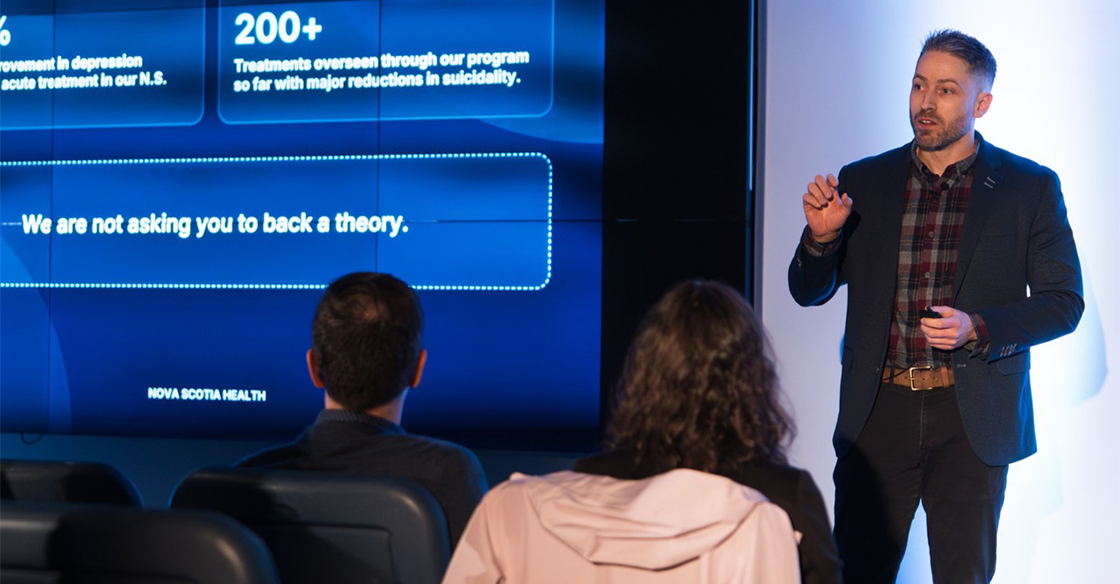
In April 2026, Dr. Nunes brought his latest research around ketamine therapy for treatment-resistant depression to the QEII Foundation’s Innovation Den stage, inspiring a jury — made up of Foundation donors — to award him the event’s inaugural $75,000 People’s Choice Award.
The funds will support his research into the effectiveness and safety of ketamine therapy for depression via a sublingual (under tongue) tablet, using a large dataset from the United States.
Dr. Nunes notes that intravenously delivered ketamine therapy for depression has resulted in remarkable improvements for patients living with difficult-to-treat depression. “If you know somebody who's benefited from this infusion therapy for their depression, it can be remarkable." However, he notes that the therapy is difficult to access due to financial and geographic barriers, given that most treatments are offered privately (which can be expensive), and in the Halifax region, which limits accessibility for people living outside of the city.
Dr. Nunes notes that in the United States, there are many people receiving ketamine therapy using sublingual tablets at home, prescribed by their local teams, which is one method by which accessibility barriers can be removed. However, the efficacy and safety of this approach needs to be scientifically evaluated. “Our research team is going to analyze the largest data set of ketamine treatments for depression that exists of 80,000 people treated at-home with sublingual ketamine in the United States,” says Dr. Nunes. He aims to use these data to learn as much as possible about how well the treatment works, and its safety profile in this large American cohort. “The funding from the QEII Foundation’s Innovation Den is going to be essentially for a team of data analysts so that we can answer the many different questions we have right now.”
Dr. Nunes notes that, with respect to learning about novel treatments for depression, time is of the essence, because in March 2027 the federal government is looking to expand access to medical assistance in dying (MAID) to people whose sole condition is depression and other mental illnesses.
When it comes to the risks associated with ketamine therapy, Dr. Nunes acknowledges he shares those concerns.
“Ketamine has risks. It can be addictive." I'm not talking about building a program that gives casual access [to ketamine].”
The goal of Dr. Nunes’ research is to evaluate if and how ketamine therapy can be provided “for the right patient at the right time with the right monitoring guidelines.”
“With funding, we can potentially save a lot of people's lives.” Dr. Nunes further notes that “we can give hope to people who, when they are referred to me, genuinely feel like they have none. Our goal is to offer more options as time goes on for people that don't respond to what already exists.”
On April 16, 2026, the QEII Foundation’s Innovation Den took place at the QEII’s Halifax Infirmary in partnership with Nova Scotia Health Research.
As part of its We Are campaign, the QEII Foundation’s Innovation Den awards are funded through its Innovation Catalyst Fund grant program, established with a $1-million gift from Susan Crocker and the late John Hunkin in 2023. The goal of their generosity was to transform healthcare innovation in Nova Scotia, challenging others to match their gift and double the annual impact to $200,000 to groundbreaking researchers.
To learn more about the QEII Foundation’s Innovation Den and our 2026 finalists, click here.