

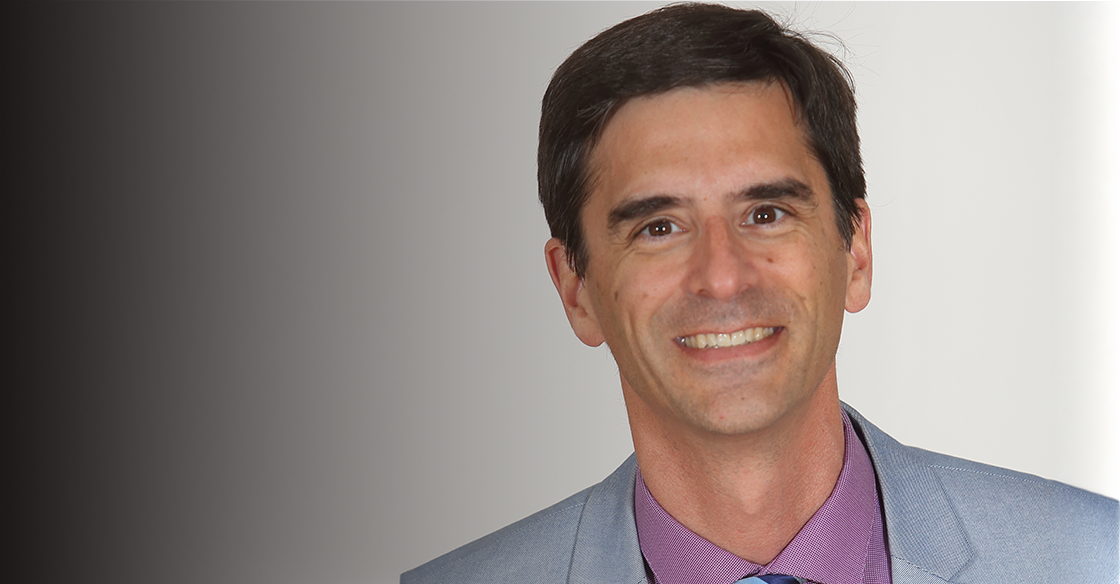
Every day, healthcare teams throughout the QEII Health Sciences Centre aim to get to the heart of a wide array of medical issues. Halifax’s own Dr. John Sapp works to get to the heart of heart health issues.
A world-renowned cardiologist, Dr. Sapp, specializes in heart rhythm research at the QEII. He has also seen growth from the investment in heart health care and research as an honorary trustee of the QEII Foundation — having experienced that impact firsthand, both through donor-funded grants and within care areas transformed by philanthropy.
The focus of Dr. Sapp’s latest research, the END-VT study, took the spotlight during the QEII Foundation’s Innovation Den in April 2026, where judges, donors and the audience learned that when it comes to being protected from cardiac arrest, it is truly all about the timing.
Q: You’re no stranger to being a leader in heart health research. What is your latest research exploring?
A: I specialize in heart rhythm research, especially the worst kind of heart rhythms which can lead to cardiac arrest. The good part about that, and the part that moves me every time, is that I get to see miracles — I get to see the people who survive.
Cardiac arrest happens when a person's heart stops. It can stop with the most common, rapid, dangerous heart rhythm called ventricular tachycardia (VT) — an irregular electrical impulse starting in the lower chambers of the heart make the heart beat so fast that it is barely pumping— or an even worse one called ventricular fibrillation (VF) in which the heart’s lower chambers just quiver instead of pumping. A person may survive a cardiac arrest, but the story doesn’t end there — we need to be able to stop them from having another cardiac arrest and protect them. This is what my latest research is exploring, and my goal is to extend this study to people who suffer from the most dangerous heart rhythms.
Q: If we look at people who suffer cardiac arrest, which of the heart rhythms is the biggest culprit?
A: I would say about 80 per cent of cardiac arrests occur because of VT while 20 per cent are due to VF where the heart needs to be shocked right away. In this latest research, I’m focusing on how we protect people from a second cardiac arrest. You can be equipped with a defibrillator, which watches every single heartbeat 24/7. The equipment is there to rescue, but it doesn't actually prevent the bad rhythm.
Q: So how is your current research looking at preventing additional cardiac arrests for a patient?
A: Currently, we have to either use very strong drugs or a procedure that's called a catheter ablation, where we put wires up into the heart and try to find the short circuits and cauterize them. I think it's fair to say that the QEII is at the leading edge in the treatment and investigation of this heart disease. Our work in this allowed us to lead and put together a team of researchers all across Canada, as well as in the United States and Europe, to do clinical trials to study these treatments. The two studies (one in 2016, and then just last year in 2025) have shown that catheter ablation is better than the really strong drugs. Sometimes we need to use both together, but this shows the world that the ablation procedure is better, and it's changed the way medicine is practiced around the world. New guidelines will recommend this as the first-line treatment. Now we are moving to the next big question of when should we be doing these ablations or using strong drugs. We are going to get those answers.
Q: Tell us about your END-VT study, which you recently received federal funding for?
A: We were very fortunate to get funding for this study, in which my team of colleagues across Canada will enroll a thousand patients who've had VT, and we're going to know just about everything about their heart care. We'll follow them closely, finding out what predicts those bad outcomes. It takes a huge team. We were fortunate to receive $1 million in funding from the Canadian Institutes of Health Research; it’s a real vote of confidence in the importance and rigor of the science to get this kind of grant. That funding allows us to enroll the patients who have had VT rhythms, but it isn’t enough to enroll patients with the worst kind of rhythm, VF. Now we are looking for additional funding to enroll every patient who has a cardiac arrest or a life-threatening heart rhythm in this study and learn what to do about that for everybody. I'm hoping we can pull off a few more miracles.
Q: How will getting the timing of these treatments right translate into measurable improvements in survival and patient outcomes?
A: We know that the treatments work, but of course they have risks. We don't have enough good data on when the risks/benefits pay off. There's risk from doing the invasive procedure on the heart. There's risk from those very strong drugs. So, by analyzing the outcomes along the way (in this study) we’ll see when that intervention has its best effect, and that's going to change practice along the way. We'll also learn a whole lot of other things that we don't know enough about, like dangerous heart rhythms in women, or in people whose heart disease is not from a heart attack, but from other forms of heart disease. So, there are all kinds of things that we'll pick up along the way.
Q: What's the toughest operational challenge to implementing this at the QEII? And what's your plan to solve it?
A: You know, there isn’t a huge operational challenge to getting this study going. We started this as a pilot study to make sure it would work, and then branched out to several other centres, just to make sure we've got all the bits and pieces of it working. With the additional funding we received recently, we are now rolling it out across Canada. And it's going well. We're leading this international multi-centre study right here, out of the QEII. The heart of this research is happening within the QEII’s Beth Medjuck Heart Rhythm Laboratory where we analyze rhythms that actually can be used in other studies as well. The impact is far-reaching and well underway.
As Atlantic Canada’s specialized cardiac centre, the QEII continues to set the pace for how heart rhythm disorders are understood, treated and prevented — with QEII Foundation donor support helping to power that progress at every step. From advancing discovery in the Beth Medjuck Heart Rhythm Laboratory and enabling life-changing procedures in the Joseph Shannon Family Cardiac Catheterization Suite, to fueling bold ideas through the Maritime Heart Centre Innovation Fund, this is what’s possible when philanthropy and clinical leadership move together. It’s support that not only drives Dr. Sapp’s world-leading research forward but also strengthens the care patients and families rely on every day — here at home, and across the region.