

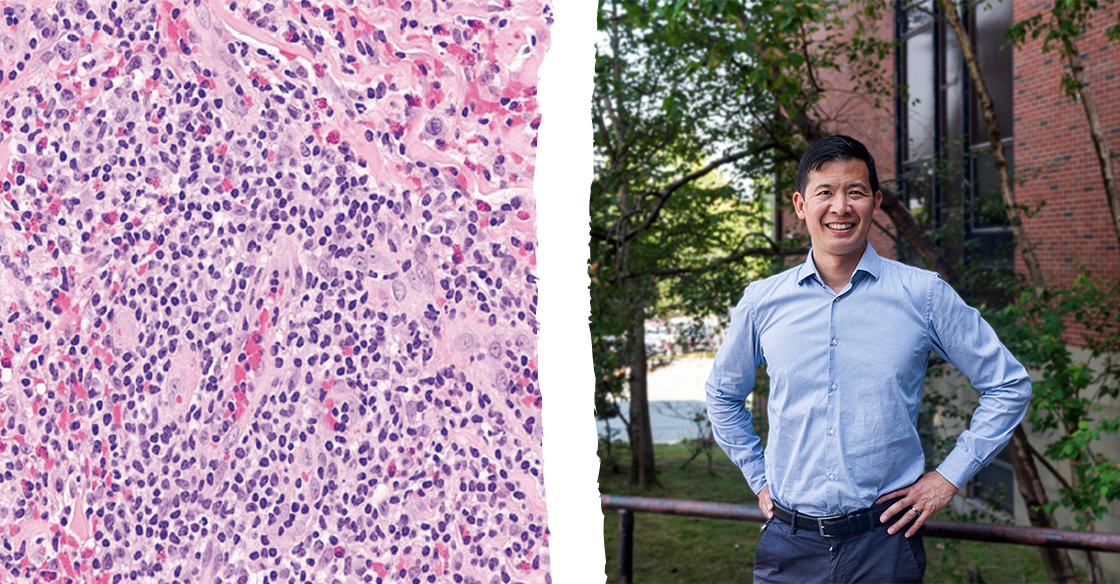
Strain of lymphocytic variant hyper eosinophilic syndrome (L-HES) magnified x20 (left); and Dr. Luke Chen, rare disease specialist at the QEII, who made the first diagnosis of L-HES in Atlantic Canada (right).
Unique. Standout. Uncommon. As the song says, one is the loneliest number, but what if you were the only person in Atlantic Canada to have a disease that just a few medical professionals know to look for?
In 2021, Cynthia McNeil was living in Alberta when she started to develop rashes that continuously stumped physicians.
“My family doctor thought it could be lupus. They thought it could be lymphoma, which my brother had. My blood counts continued to be off though, which is when they sent me for a full day of testing in Edmonton — a bone marrow test, skin biopsies and more blood tests.”
The tests continued to lean towards a lymphoma diagnosis, but doctors agreed the tests weren’t definitive enough for a diagnosis.
Now with a growing family, Cynthia decided it was time to move home to New Brunswick in 2023. On their way cross-country, they stopped in Ontario to visit family, where Cynthia’s health took a turn.
“My leg got really swollen. So swollen that if I crouched down, it would hurt. Then I got this itchy rash band on my legs. They looked disgusting. When we arrived in New Brunswick, I went to the emergency department at the local hospital and was sent for more testing.”
Cynthia was referred to a hematologist in Moncton, who had never seen a rash like hers before.
“The test results came back very quick and she called to tell me my health issues had progressed into a lymphoma for sure — I would have to start doing treatments and I was going to have to get a bone marrow transplant.”
Cynthia started chemotherapy and was also prepared to have her bone marrow transplant.
“The information about the transplant was terrifying. I also learned the chemo treatments would essentially kill my reproductive system, so I wasn’t going to be able to have any more children. I was shocked at it all.”
After several rounds of chemotherapy and a month where doctors sent her test results off to specialists in Toronto as they were still unsure if it was lymphoma, Cynthia was preparing for what they call the “doom” chemotherapy, as it is 200 times stronger than a regular therapy.
“I’m admitted for this ‘doom’ chemo when suddenly one tiny little spot on my leg that had come back, which meant we couldn’t move forward with the treatment and they sent me home.
Cynthia returned to Miramichi, frustrated and exhausted from her health journey, with yet another rash she needs to heal. One day, she receives a call from Dr. Luke Chen, a rare disease specialist at the QEII Health Sciences Centre.
“He was straight to the point. He said he looked over my blood tests and he didn’t think I ever had lymphoma. He believed it was the lymphocytic variant hyper eosinophilic syndrome (L-HES) and asked me to come see him at the QEII.”
L-HES is a rare immune system disorder where a group of abnormal white blood cells (T-cells) overproduces a chemical messenger. This chemical constantly signals your bone marrow to create too many eosinophils (another type of white blood cell).
With the hope of being cancer free fueling her, Cynthia made her way to Halifax for further testing.
Dr. Chen says the way you find these abnormal T-cells is by a simple test called flow cytometry.
“Every large hospital in the world has flow cytometry available to them. It's a very standard test. Except our standard flow cytometry to look at lymphocytes will not pick up these abnormal T-cells unless you look for them. It doesn’t cost extra money — you just need to adjust the test and the way they analyze results very, very slightly.”
And with that test, Cynthia became the first person in Atlantic Canada to be diagnosed with L-HES — a disease with a new case incidence of less than1 in 500,000 people per year, according to Dr. Chen.
“When I came to practice at the QEII in 2023, I had been talking to the lab when I first got here about adjusting their flow to look for this L-HES, but we didn't have an index case yet, until Cynthia. And hers is more severe than any case I've personally seen. I put her on the treatment for L-HES, and her skin is perfect now. She's in great shape.”
Cynthia’s case was so dramatic in Dr. Chen’s eyes that he and his trainees Dr. Chris Liwski (a pathology resident at Dalhousie University) and Taylor Skinner (medical student at Memorial University of Newfoundland) decided to write a paper about this L-HES discovery.
“Patients go to the doctor because they have these terrible rashes so a dermatologist will likely make first contact with a case, but almost none of the papers on L-HES are published in dermatology journals. I sent our paper to the Journal of the American Medical Association (JAMA) - Dermatology — it is one of the most important Dermatology and skin science journals in the world. We were very proud to have our paper published in the July 2026 issue of JAMA Dermatology to help educate our colleagues on L-HES, and the discovery and work done here at the QEII.”
The QEII houses a first of its kind program called the Coastal Rare Diseases Program (CoRID), welcoming 20 to 30 patients each month from all over the East Coast. At CoRID, Dr. Chen evaluates patients with rare inflammatory blood diseases, conducts research into conditions such as L-HES, histiocyte disorders, Castleman disease, hemophagocytic lymphohistiocytosis, IgG4-related disease and VEXAS.
As for Cynthia, since starting the medication Dr. Chen prescribed to her, she hasn’t had any reoccurrence of the rash since.
“Looking back at my health journey, it was such a rollercoaster. I’m super happy I didn’t have to go through the final chemo treatment. I had psyched myself up for it for so long and then to get the call from Dr. Chen and realized I didn’t have to go through that was amazing, but sad at the same time. I cried for days. Sometimes I get annoyed that we couldn’t figure out what it was sooner.”
“I’m so thankful for Dr. Chen and the team at the QEII. They're also nice. They're honest. They follow through — I just can’t say enough good things about them. I now know what Dr. Chen has been able to do for other like me with rare diseases — thank God for him!”