

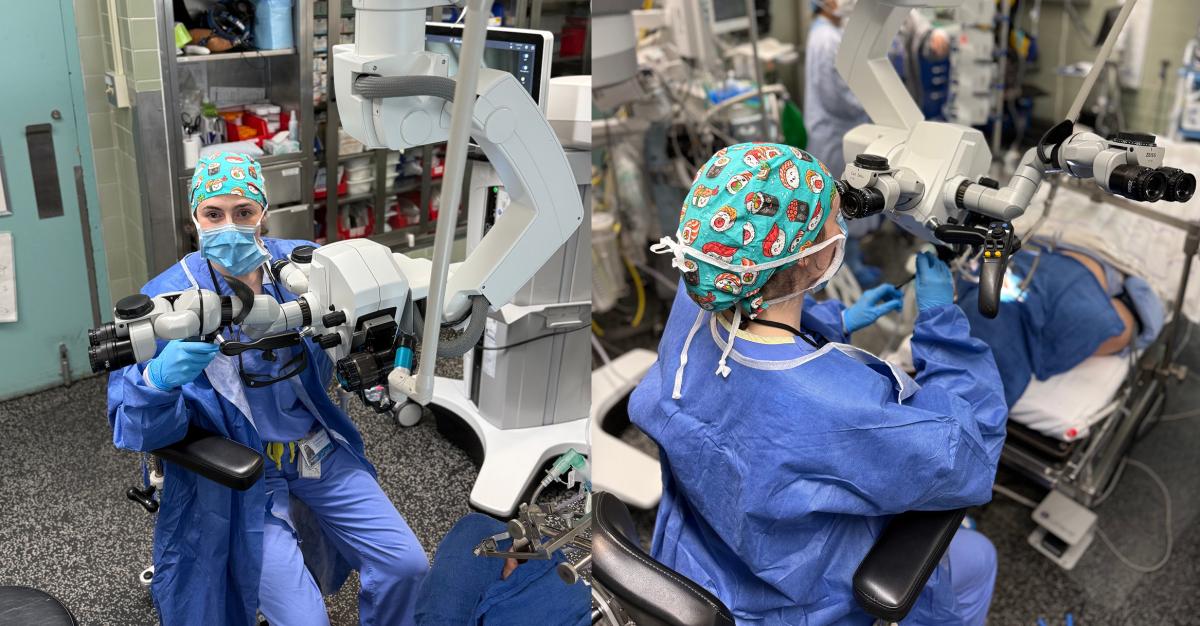
Dr. Hannah Brennan, a QEII resident using CO2 laser technology with a microscope. Thanks to support from QEII Foundation donors, including Islanders from the QEII Foundation's Evening of Inspiration, the QEII will receive a new CO2 laser to replace outdated technology.
The Carbon Dioxide (CO2) laser was initially designed for head and neck surgeries (otolaryngology) and gynecology procedures, including tumour removals and even extending into eye surgery. Today, the CO2 laser is an advancement in medical technology that allows for greater surgical control and minimized damage to surrounding tissues resulting in potentially faster post surgery recovery and improved patient outcomes.
In the early 2000’s the QEII’s Dr. Mark Taylor, Division Head of Otolaryngology, led the charge to bring the CO2 laser to the QEII Health Sciences Centre. Since then, the laser has had remarkable success in removing laryngeal cancers in just a one-hour procedure. This replaced what used to be a very long and stressful six-week radiation treatment. Both procedures had around the same success rate, except that the one-hour procedure using the CO2 laser minimizes possible side effects following radiation treatment.
The latest advancement in CO2 laser technology is fiber technology. Fiber technology provides surgeons with access to difficult-to-reach anatomy making surgeries more efficient and less invasive. Dr. Matthew Rigby, a QEII head and neck surgeon part of the Division of Otolaryngology who uses the CO2 laser often says that “the new laser will have the ability to use fibers that actually bend your beam so you can cut around corners, which is really helpful. It’s given us another option in trying to both provide a cure and maximize patient function and quality of life.”
Upper aerodigestive cancers, which are cancers of the throat lining and include cancers in the tonsils, voice box, and tongue-based cancers like QEII patient Troy Greencorn had are also cancers that are easier to operate on thanks to the CO2 laser.
People from across the Maritimes travel to the QEII for care especially because of the specialized technology like the CO2 laser the QEII offers that is not available in the rest of the Maritimes.
Originally from Canso, N.S., Troy lives and works in Pictou County. Troy was highly satisfied with the treatment he received by his QEII medical team and was glad he was referred directly to the ENT unit at the Dickson Centre. He was very impressed with the level of holistic care his team took to make sure he was looked after: “My healthcare experience with the QEII was incredibly positive. Although my first appointment brought crushing news that I had cancer, I was amazed from the start with the comprehensive team approach to care and the level of expertise. Cancer instantly creates mental health strains for patients and a counselor was immediately available to me. Having our incredible navigator Alison Rhynard on the team reduced so much anxiety. I was completely humbled that the tumour board, of 20 or more medical professionals evaluated every case to make collaborative recommendations. I don’t know if people understand this level of expertise lies behind treatment choices.”
Troy was seen in December 2025 at the QEII’s Cancer Centre. After several biopsies were conducted, Troy was entrusted into the capable hands of Dr. Rigby where he had a procedure completed using the CO2 laser and a large tumour was removed orally as well as neck dissection and lymph node removal. The major surgery led to Troy losing 20 pounds due to limitations in his diet, only being able to eat liquids and soft foods during his recovery. However, Troy expresses that as the CO2 laser was less invasive than other surgical methods would have been, his recovery was quicker and resulted in less scarring — a valuable result for Troy given his work in the entertainment industry.
For Troy, the importance of the CO2 laser surgery became clear when he began preparing for radiation treatments following his surgery. Dr. Derek Wilkie at the Department of Radiation Oncology informed Troy that his surgery was a success and that no following radiation was required. “We were literally at the intake and planning session when our team led by Dr. Wilkie shared this great news, for us it was clearly a miracle of modern medicine and the prayers of our enormous support system of family and friends," Troy says. This incredible news meant that Troy would not have to go through more physically and mentally demanding treatment.
“To be heading towards a course of 30 radiation treatments and learn that my surgery was so successful that radiation wouldn’t be needed, was one of the best gifts I could ever have been given,” says Troy.
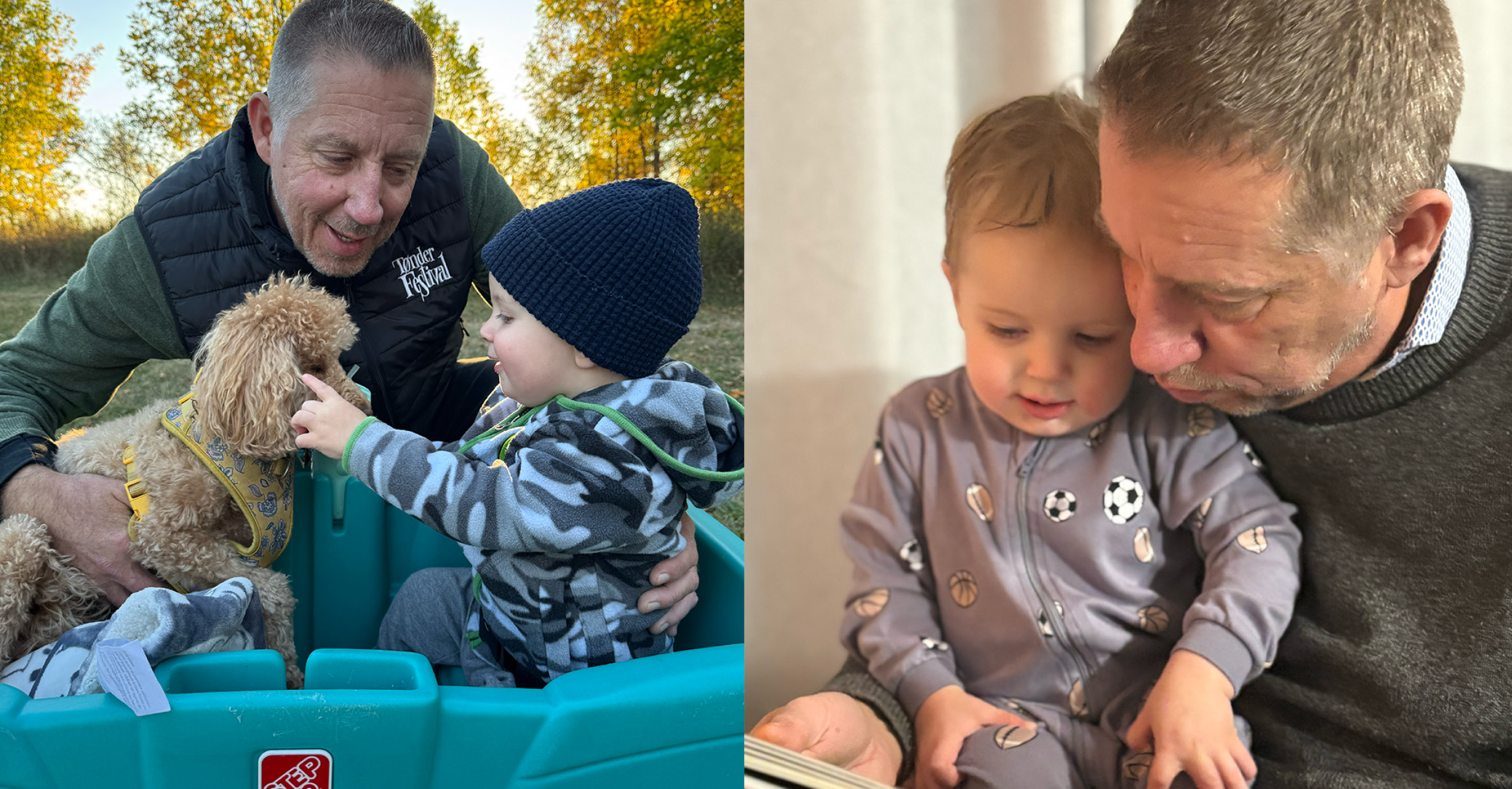
Without the laser, Troy and other patients would not have access to the latest in advanced treatments. “It really is an important part of our treatment to giving patients options that maximize both survival and functional outcomes,” says Dr. Rigby.
The fact that the medical team using the CO2 laser was successful in Troy’s surgery means that he, like many others, was spared from an even longer journey to recovery.
Although the CO2 laser was used on Troy, some surgeries may be delayed because of a backlog of patients waiting to use it. This reflects how the QEII needs additional equipment to expand their care to Nova Scotians who need it most. Dr. Rigby says that while the QEII currently has two CO2 lasers, he explains that they are older models. “In the past few years, the OR has been down to just one or even zero functional lasers when repairs were needed.”
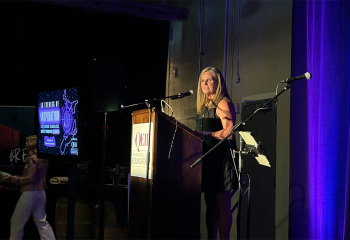
During the QEII Foundation’s Evening of Inspiration event held on Prince Edward Island in June 2025, Nova Scotians and Islanders raised more than $250,000 to bring the latest CO2 laser technology available to the QEII, which will allow specialized surgery to be more accessible for Maritimers, increasing patient access, reducing surgical risks, improving patient outcomes and recovery rates and helping patients heal faster. This is thanks to the CO2 laser’s expertise in greater precision and fewer invasive procedures.
“Contributions to the QEII Foundation are critical to increasing the diagnostic and treatment capabilities available. Shorter wait times save lives in cancer care,” says Troy.
The Orchid Women’s Health Initiative (OWHI) is a proud supporter of the CO2 laser, especially for its use in gynecology — another feature the laser is often used for since it is an effective treatment for HPV-related lesions and other gynecological conditions. The CO2 laser has become indispensable in the medical world and with the fiber add-on, a new generation of laser technology will soon be brought to the QEII. Liz Rigney and Sheri Morgan of the OWHI led the QEII Foundation’s Evening of Inspiration, an event that solidified goals and a vision for CO2 laser technology.
While the QEII Foundation works to help advance care through the QEII Health Sciences Centre, this crucial support from donors means that Troy and other patients can get the care they need while undergoing fewer procedures and receiving more advanced care. The QEII is Atlantic Canada’s largest and most specialized adult health sciences centre, and the QEII Foundation and our donor community helps to improve patient care for Atlantic Canadians by bringing more sustainable and advanced technology so that healthcare professionals can help patients in new ways.
The CO2 laser is part of the QEII Foundation’s $100-million We Are campaign. Now that its $250,000 project funding is complete thanks to donor generosity, QEII teams are ready and excited for the arrival of this new best-in-class technology.