

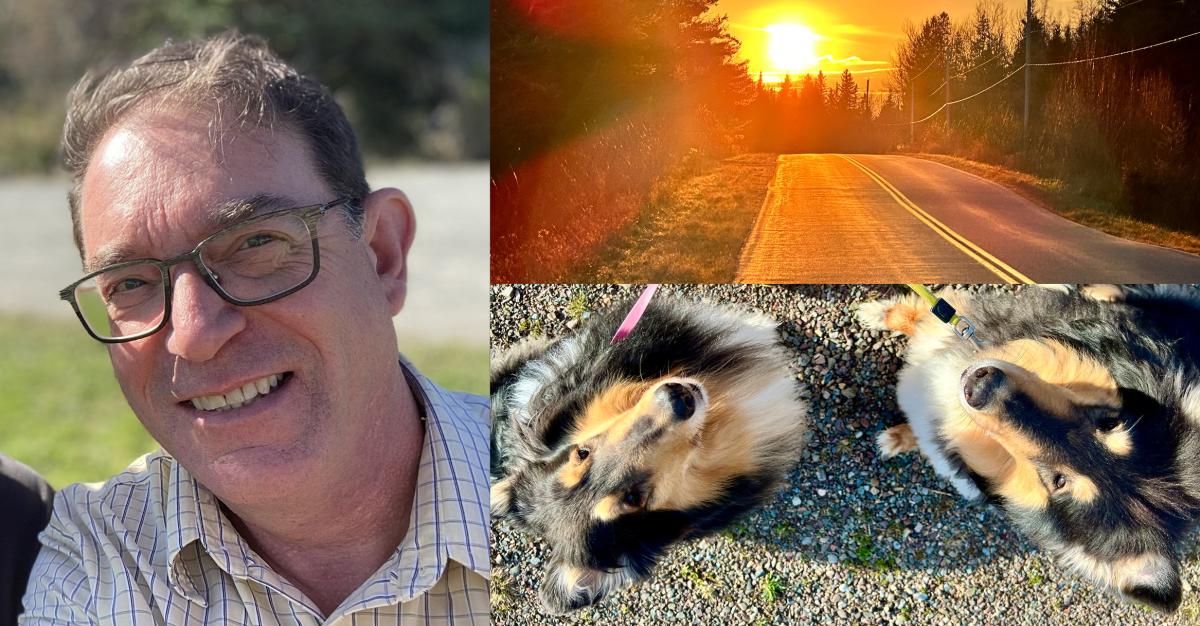
Carl Fraser from Stewiacke Nova Scotia, his two rough collies and a view from Carl's daily morning walk. Carl received life-changing spinal surgery from the QEII Health Sciences Centre in 2020, restoring function and allowing him to walk and enjoy nature.
Throughout his nearly 25 years as a parish priest, Carl Fraser visited many patients and families receiving care at QEII Health Sciences Centre, offering comfort during some of the most difficult moments of their lives.
“I’ve had lots of opportunity to be in the QEII, to see people cared for on some of their hardest and worst days, and to witness the care and professionalism,” he says.
In 2020, Carl’s connection to the QEII shifted to a more personal one when he instead found himself on the other side of care as a patient.
That October, after years of unexplained symptoms including chronic back and pelvic pain, Carl received a life-changing diagnosis: a spinal cord tumour. The tumour, unfortunately, had already profoundly affected his function.
“My neurosurgeon told me I needed almost immediate surgery because I was on the verge of possible catastrophic disability,” Carl recalls. “I had lost between 75 and 80 per cent of my spinal cord function below the tumour.”
Just weeks later, on November 3, 2020, Carl underwent spinal surgery at the QEII with Dr. Jacob Alant to remove the tumour.
Carl then spent six days recovering on the QEII’s neurosurgery floor during the height of the COVID-19 pandemic, when safety protocols meant limited visitors and additional challenges for patients and care providers alike.
For the first few days after surgery, Carl was unable to care for himself – a vulnerable feeling at any time but especially amplified by the uncertainty of the pandemic. Carl explains that even amid unprecedented challenges, QEII staff went above and beyond to make sure that his every need was addressed with compassion and care.
“In that position where I really could do nothing for myself, the nurses and the staff and the neurosurgeon were just incredibly kind and thoughtful,” he says. “I can’t describe what it was like to be given so much care.”
Thankfully, Carl’s surgeon was able to remove his cancer during surgery without additional radiation or chemotherapy, but his recovery would be still long and challenging.
After returning home, he spent 18 months on disability leave from work while he relearned how to walk and adapted to the effects of removing the tumour and surgery, all while receiving further care for urology and physiotherapy.
He describes each of the healthcare professionals that he encountered during his recovery as “a gift.”
“Every time I found myself in front of someone, they were just the right person that I needed to be talking to at that time in order to be able to help me on my journey.”
Today, Carl continues to live with some lasting effects from the surgery, including chronic neurological pain, but his outlook is overwhelmingly positive.
“I say my life was given back to me through the surgery,” he says. “Life is full and beautiful. I think my life is better now in so many ways.”
Carl and his wife currently live on a quiet, wooded property in Stewiacke, Nova Scotia, where they enjoy spending time in the serenity of nature with their two rough collies. Carl especially enjoys taking in the beautiful view from his porch, and loves snowy, wintery days.
Every morning, Carl goes for a walk in the woods, a simple pleasure that once seemed uncertain.
“For the last three and a half years, I’ve walked every day,” he says. “About three kilometers in the morning when my system is at its best.”
“It’s become such an important gift to myself each day.”
During his recovery, Carl was also unsure if he was going to be able to return to his career.
“I didn’t know whether or not I’d ever be able to return to the work that I love,” he says. “But I was finally able to.”
Now, Carl is serving as Vocations Coordinator for the Anglican Diocese of Nova Scotia and Prince Edward Island – an exciting and rewarding role.
After settling into his new routine post-surgery, Carl and his wife began thinking about how they could give back to the QEII healthcare teams who dedicated their skills, time and compassion to Carl during such a difficult time in his life.
“I said to my wife, we need to find a way to recognize the incredible work of our healthcare staff,” Carl says. “I’m grateful, and I give because so much has been given to me.”
Carl and his wife chose to become QEII Change Makers, making monthly donations to the QEII Foundation.
For the couple, monthly giving is a practical choice.
“Monthly gifts make it possible for us to do something consistently that hopefully makes a difference.”
They direct one QEII Foundation monthly gift towards neurosurgery – the department that cared for him – and another towards the QEII’s Highest Priority Needs.
Carl believes strongly in the power of community generosity coming together, something that the QEII Change Makers program embodies.
“The reality is that we don’t always have the capacity or the money to do everything,” he says. “But that also means there’s an opportunity for each of us to make our own difference.”
Even small contributions can have a powerful impact when people rally to make a difference. With over 600 monthly donors currently supporting the QEII Foundation, each contribution joins together to make a big collective impact.
As Carl remarks: “When your little bit is combined with everybody else’s little bit, it makes a huge difference.”
Today, Carl is appreciating each day, and is still followed by the QEII’s neurosurgery department, with Dr. Sean Christie stepping in as his most recent care provider. Carl is happy to express his thanks through monthly giving for exceptional care that meant everything to him during such an uncertain time.
“They were there for me at a really critical, life-changing moment,” he says of the QEII care teams that supported him every step of the way. “Giving back is just one way to say thank you.”