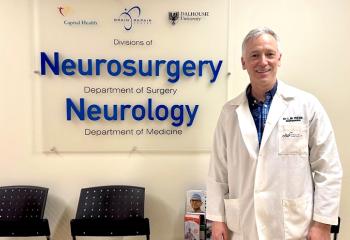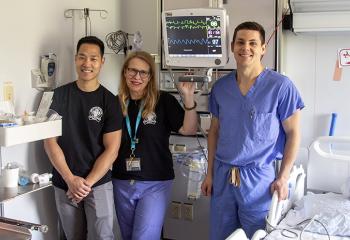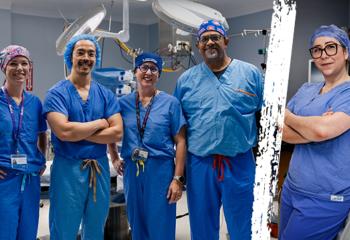


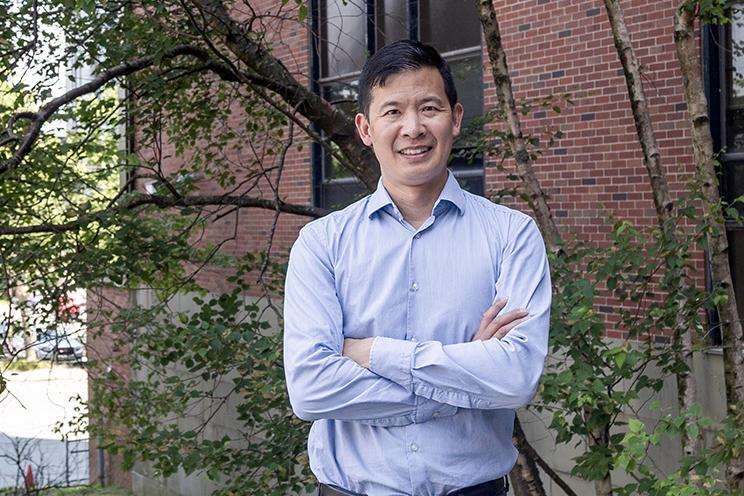
QEII hematologist Dr. Luke Chen returned home to Halifax following 15 years in Vancouver. Dr. Chen brought his expertise in rare inflammatory blood diseases to the QEII and has since launched the Coastal Rare Inflammatory Disease Program (CoRID), supporting the care of those with inflammatory blood diseases. QEII FOUNDATION
Advancing patient care for people with rare disorders
It was April 2021 and Merek Jagielski was battling a range of mysterious symptoms. After being treated at Dartmouth General Hospital for a blood clot in his leg, Merek went on to develop severe skin lesions, internal inflammation and a high fever. A second blood clot landed him back at the hospital.
“They were quite perplexed,” the Dartmouth resident recalls. “They didn’t know if it was a skin disease or some kind of internal infection.”
After exhaustive testing Merek was referred to QEII dermatologist, Dr. Peter Green, and QEII rheumatologist, Dr. Alexandra Legge. Through genetic testing Merek was diagnosed in 2023 with VEXAS syndrome, a severe, adult-onset autoinflammatory disease in which the immune system mistakenly attacks the body. He became the first person in Nova Scotia to be diagnosed with this condition.
VEXAS syndrome was discovered by Dr. David Beck at the US National Institute of Health in 2020 and is estimated to affect one in 14,000 people, primarily men over age 50. This rare disease, which can be fatal if left untreated, is triggered by acquired changes in a specific gene, UBA1, with symptoms that include recurrent fevers, severe fatigue, painful skin rashes, swollen cartilage, lung inflammation, and a high risk of blood clots.
Dr. Luke Chen’s relocation to Halifax from Vancouver in September 2023 was a homecoming of sorts, as he grew up in Halifax and attended medical school at Dalhousie University before becoming a hematologist at Vancouver General Hospital.
Over his 15 years in Vancouver, Dr. Chen developed a specialty in rare inflammatory blood diseases, including VEXAS, histiocyte disorders, hemophagocytic lymphohistiocytosis (HLH), IgG4-related disease, eosinophilic disorders, Castleman disease, and Still’s disease. Dr. Chen diagnosed the first case of VEXAS in Canada a few weeks after Dr. Beck’s landmark paper was published.
While bringing that expertise to the QEII, Dr. Chen also launched the Coastal Rare Inflammatory Disease Program (CoRID), which supports the care of those with inflammatory blood diseases.
“When I moved back here, I realized there was an opportunity to create something unique in Canada,” Dr. Chen says.
The mission of CoRID is threefold:
Patient care: CoRID is a referral centre for patients from Atlantic Canada to B.C., and beyond. Hence the “Coastal” name. Patients in Atlantic Canada with these rare diseases are referred to Dr. Chen, and he also offers advice to physicians across the country.
“Many physicians might see these diseases once in their entire career, and when you see something for the first time it can be very daunting,” Dr. Chen points out. “Because these diseases are rare there are not a lot of people with that expertise.”
Research: Dr. Chen conducts research in collaboration with other centres, particularly the University of Pennsylvania, Harvard and Every Cure (New York). Dr. Chen remains an Affiliate Professor at the University of British Columbia.
Education: CoRID is training the next generation of physicians specializing in rare inflammatory diseases. Dr. Mariam Gouban, who completed her hematology fellowship at the University of British Columbia, has come to Halifax to study with Dr. Chen for a year as the first CoRID Fellow.
Merek was referred to Dr. Chen the year he arrived, and a treatment plan was developed that includes monthly injections at the QEII’s hematology clinic, as well as prescribed medications.
“They have a wonderful team at the QEII. I am always amazed by their commitment and dedication,” Merek says. “When I go in, I joke that I am here for my spa treatment.”
Merek is one of just five VEXAS cases identified across the three Maritime provinces, but Dr. Chen points out that number suggests there are many “hidden” cases. Statistically there should be 75 to 80 cases in Nova Scotia alone.
“Some people may have milder forms, and some people might not know they have it,” he says. “There are a lot of cases that need to be identified. It’s a serious disease, and it needs to be treated.”
“This is why my team is so invested in the work of identifying and treating rare blood diseases — no one should have to suffer when the treatment for their condition may be sitting right there on our pharmacy shelf,” Dr. Chen continues. “And we have a great foundation here at the QEII — Dr. Green and Dr. Legge had already diagnosed Mr. Jagielski; I came along at the right time to get him started on treatment.”
Now in remission, Merek retired two years ago after a career in immigrant settlement. The ability to walk, to travel and to enjoy life will have immeasurable impact on his retirement years. He and his wife have since visited Europe, B.C. and North Carolina, and are now planning an Alaskan cruise.
“It was very lucky for me that Dr. Chen appeared on the horizon,” Merek says. “My quality of life is much better than it was three years ago.”