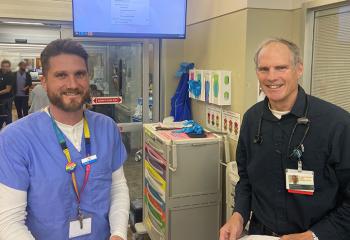



Dr. Phil Tibbo (left) and Dr. Amanda Vinson (right) are the first two grant recipients of the QEII Foundation’s Health Equity Fund, created through a $1-million donation from Emera. The fund is providing grants to healthcare leaders and researchers whose work is advancing health equity for populations across Nova Scotia. CONTRIBUTED
First-in-Canada QEII Foundation Health Equity Fund supporting local researchers
A Canadian first to activate intentional solutions to deliver more equitable health care has taken its first steps.
Announced in January 2025, the QEII Foundation’s Health Equity Fund is providing grants to healthcare leaders and researchers whose work is advancing health equity for populations across Nova Scotia.
Administered by Nova Scotia Health, these grants are funded by a $1-million donation to the QEII Foundation from Emera — $200,000 annually for the next five years — as part of the QEII Foundation’s $100-million We Are campaign to transform health care at and through the QEII Health Sciences Centre.
Susan Mullin, president and CEO of the QEII Foundation, says the vision is that someday health equity will be standard of care.
“At every stage of health care, from research to planning health services and delivering care, diverse perspectives are required. Truly examining all aspects of healthcare delivery requires an investment and a commitment for making our community stronger, more innovative and more inclusive,” Susan says.
The first recipients of these grants were announced in October 2025.
Dr. Phil Tibbo, Paul Janssen Chair in Psychotic Disorders, Department of Psychiatry, Dalhousie, QEII Health Sciences Centre, is leading the innovative schizophrenia and other psychotic disorders project. With approximately 29,000 Nova Scotians impacted by these disorders, there is a critical need to examine if the early psychosis intervention services are being sensitive to rural living and delivered in a culturally appropriate way for new Canadians, African Nova Scotians, black youth and young adults.
“We realize that rural youth and rural young adults face challenges when it comes to mental health care. There’s potential for more stigma in small towns — even access to public transportation. Sometimes the patients and their families or support people need to drive a fair distance to get the care they need,” explains Dr. Tibbo.
“We also need to consider how health care is funded and what programs are set up in rural communities. We want to make sure that from an equity standpoint, we have the exact same care happening within these rural populations.”
While Dr. Tibbo acknowledges Nova Scotia’s population is now 48 per cent rural, he also points out the provincial rural population is growing and becoming more diverse with new Canadians.
With a research assistant now in place, Dr. Tibbo anticipates the work funded by the QEII Foundation’s Health Equity Fund will begin in early 2026, taking two years to complete. The research will include looking at the current provincial measurements in place for psychotic disorder care in Nova Scotia, along with surveying and focus groups of people from different populations.
Dr. Tibbo is grateful for the support of the QEII Foundation and acknowledges the impact of donors like Emera.
“Having access to this funding allows us to move forward and ensure equitable care across the province,” he says. “Donors are so important to this work.”
Dr. Amanda Vinson, QEII transplant nephrologist and Health Equity Fund grant recipient, agrees.
“This funding is such a gift to help get this research off the ground, for me but more importantly, for our patients,” she says. “If there are inequities there, we need to know what they are. It's not reasonable to continue the status quo without questioning if it’s fair for our patients.”
Dr. Vinson’s research will examine whether a rural disadvantage exists for kidney transplant patients in a Canadian population — in particular, in Nova Scotia — around timely access and how well someone does after receiving a new kidney.
“If there are disparities in access to, or outcomes after, a liver or kidney transplant for patients living in rural communities — those problems are there whether we study them or not. The most important thing is that we identify the issues so we can address them,” Dr. Vinson explains.
“Maybe more patients need to come to Halifax. Maybe we need outreach clinics for these patients or improved transplant-specific education for patients and non-specialist healthcare providers. But we need to know what the problem is before we can really institute solutions. This research will be the first step to change, if needed.”
This research will be a first of its kind in Canada, which is surprising to Dr. Vinson given a large portion of the country’s population live in rural communities.
“We want to be sure patients are receiving the care they need, regardless of where they live. I’m excited to be the one leading this research.”
The QEII Foundation’s Health Equity Fund is a meaningful step in improving access to care for all Nova Scotians.
With a critical health equity lens, both Dr. Tibbo and Dr. Vinson show great potential in identifying and closing gaps in healthcare delivery and ensuring patients are receiving the best care.