

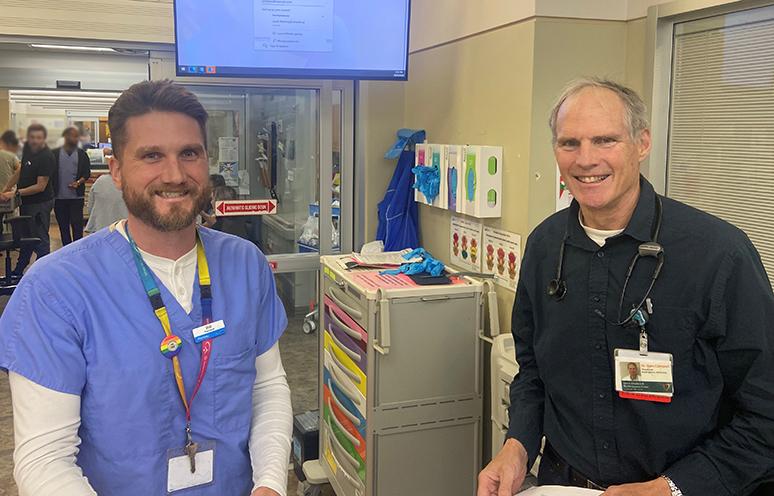
Will Nevers (left), a QEII emergency department pharmacist, recently received a QEII Foundation grant for his work to improve care for patients with opioid use disorder. Dr. Sam Campbell (right), emergency medicine physician and the research director at the QEII’s Charles V Keating Emergency and Trauma Centre, says these important grants provide an important step for young researchers. CONTRIBUTED
QEII Foundation grant supporting new research for people with opioid use disorder
Will Nevers, an emergency department (ED) pharmacist at the QEII Health Sciences Centre, has been granted a QEII Foundation Raymond L. Roberts Emergency Medicine Young Researcher’s Grant (EMYRG). His study, called “Identifying provider-perceived enablers and barriers of opioid agonist therapy for treating opioid use disorder in Nova Scotia emergency departments,” is designed to improve treatment for people with opioid use disorder.
Will, who previously worked as a clinical pharmacist in British Columbia, has worked at the QEII’s ED since 2023. In this role, he functions as an important part of the ED clinical team, taking consults on patients with challenging medication regimens and multiple medications. The pharmacist helps identify the estimated ten per cent of ED admissions that are a direct result of complications of medication, advises which medication regimens are most safe for patients, and ensures their pharmaceutical care continues when patients leave the emergency department.
Buprenorphine/naloxone is a combination of medications that can help people who are struggling with opioid use disorder. These medicines help reduce cravings and withdrawal symptoms and are safer than using illegal drugs. Another option is called safer supply, which gives people access to clean, legal alternatives to street drugs. These strategies can lower the risk of overdose and save lives.
From speaking with patients, other healthcare providers and following prescriptions on the Drug Information System, Will knows that many patients who present with problems related to opioid use disorder may not always receive buprenorphine/naloxone or other opioid agonist therapy medications. The reasons for this are not fully understood. His study will connect with healthcare workers in Halifax and Dartmouth emergency departments to learn what makes it easier—or harder—for them to use these treatments.
“My research has always been in opioid use disorder,” Will says. “The opioid pandemic started out west and has come east. I’m trying to figure out, from our emergency department point of view, is there a problem with our education? Or is it our capability? Or opportunity? Are staff comfortable doing it? Do we have the resources? Right now, there are challenges and gaps, but I don’t know where they are.”
He says the issue may occur many times in one day, or not at all for several days. “We are not always ready for when they come in and we may not be consistent,” he says. “Nova Scotia is seeing a big spike in patients with opioid use disorder presenting to the emergency department and has been growing for a few years now.”
In 2024, there were 68 confirmed and probable acute opioid toxicity deaths in Nova Scotia — a slight decrease of 6.8 per cent from the record high of 73 deaths in 2023. Nationally, there are more than about 5,000 visits per year for opioid-related poisoning across Canada.
“I think it is important that we manage this condition like any other serious condition and that the patient feels safe and supported by the healthcare workers. We need to ensure that we are providing optimal care for their substance use so they can receive other treatments that are needed,” he says.
He will create focus groups of healthcare professionals at the QEII’s Halifax Infirmary and the Dartmouth General Hospital over the first few months of 2026.
“We ultimately want patients to feel safe coming to emergency, to receive the medication in hospital and give them a sustainable plan for when they leave,” Will says.
Dr. Sam Campbell is an emergency medicine physician and the research director at the QEII’s Charles V Keating Emergency and Trauma Centre.
He says the young researchers’ grant helps people escape from a Catch 22: “You need to have research experience for people to give you grants, and you need to have grants to get research experience,” he explains.
“We need new research because things are changing so quickly in emergency medicine. You're also allowing young people to experience the value and the enjoyment of the research.”
Dr. Campbell says emergency medicine research tends to be quantitative, where you look at the numbers. This project is instead qualitative, which looks at the people behind the numbers. “We don’t know what we need to do to improve our low rates of buprenorphine/naloxone use in our EDs, and that’s why Will needs to do this research,” he explains.
The QEII Foundation Raymond L. Roberts Emergency Medicine Young Researcher’s Grant provides funding to support new researchers’ contributions to emergency medicine in Canada. The grant will help advance discovery and clinical care in emergency medicine.
Established by the QEII Foundation in 2023 through a legacy gift from the late Raymond L. Roberts, with four grants of up to $5,000 annually, EMYRG is open to new researchers or full-time staff at the QEII’s Charles V. Keating Emergency and Trauma Centre. EMYRG was created to help establish research programs and compete for external funding.
Will hopes his research will improve care.
“Evidence from other Canadian centres, as well as internationally, is increasingly revealing the positive impacts of ED treatment of opioid use disorder with decreased admissions and better clinical outcomes for patients,” he says. “By continuing to implement these strategies, with an understanding of local context as a result of this research, we hope to achieve buprenorphine/naloxone prescription as a routine practice in appropriate patients and continue to reduce the stigma faced by those patients.”
Will acknowledges the great work from Masters of Physician Assistant Studies students, Florence, Anna, Juliet and Mujtabah, who have provided tireless hours to help get this project off the ground.