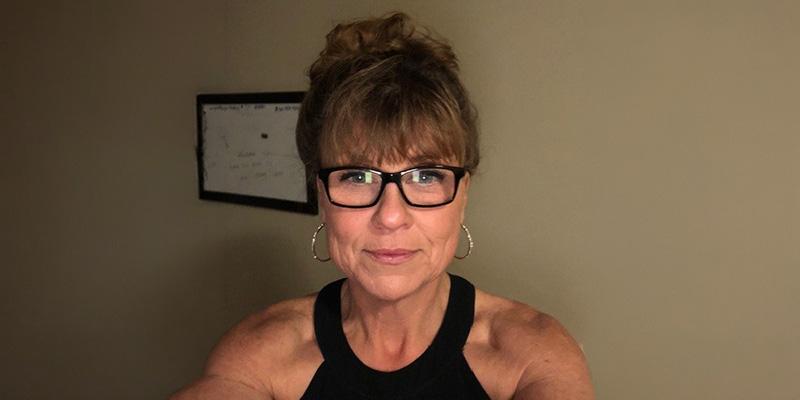
Pictured: Stacey Rice. When seeking treatment for Chronic Regional Pain Syndrom (CPRS) through a clinical trial, Stacey's scans revealed she had lung cancer. QEII care teams saved her life.
Having the courage to chase your dreams can be hard to find. As a banking professional by day, Stacey Rice of New Glasgow longed to become a motorcycle racer. When she received the call to “get in shape” for her racing debut, Stacey was ready to give it her all and sought out the carpal tunnel surgery she needed to compete.
While the minor procedure went well on her right arm, a nerve was struck during the carpal tunnel surgery on her left, leaving Stacey in excruciating pain for the following year.
“I was taking up to 20 Tylenol a day. It was the worst year of my life because no one believed me because you couldn't see the pain. But then my thumb completely stopped working while at my job, and something in me (mentally). I left my job that day and never went back.”
Stacey’s doctor sent her to the QEII Health Sciences Centre, where a plastic surgeon was able to free up the nerves involved, which cut her pain in half. It was at the QEII’s Pain Clinic where Stacey was diagnosed with complex regional pain syndrome (CRPS).
“The pain got so bad that I applied for medical assistance in dying (MAID). I was prepared to say goodbye to my family because I just couldn't let them watch me suffer anymore. When I got the call that I was accepted into Dr. Weise’s study, it was like a light at the end of the tunnel.”
Stacey was the first person accepted into Dr. Lutz Weise’s midline and dorsolateral spinal cord stimulation (MIDL/SCS) study, focusing on neuropathic (nerve) pain issues of those with complex regional pain syndrome.
“Patients with CRPS may develop the syndrome from a minor event, like an ankle injury, or can be something that develops after a surgery, where suddenly they get this ongoing severe pain in their limbs. Spinal cord stimulation has been used to help treat people with neuropathic pain issues since the 1960s, yet there has not been a study conducted on patients with CRPS using spinal cord stimulation therapy. That is what our MIDL/SCS study at the QEII is investigating," he says.
Dr. Weise and his team are recruiting 40 patients with CRPS into this study. In the first phase of this trial, two electrodes are inserted into the patient’s back — one to the spinal cord to stimulate the dorsal columns, the other to the nerve roots going into the spinal cord, which is closer to where the pain information comes into the spinal cord. Dr. Weise says the patient doesn’t feel the stimulation.
“Like a dog whistle, the frequency of the stimulation is so high that you can't feel it consciously, but it does influence the pain information coming into the spinal cord.”
“The main focus of this study is to document the effects of the different types of stimulations, like on the spinal cord versus the nerve root coming into the spinal cord, and the combination of both. The patients will undergo four different stimulation paradigms. The sequence is randomized so the patient doesn't know what we're doing when we're doing.
"At one point there will be no stimulation at all. At one point it's just the back end of the spinal cord, and sometimes it's just the nerve roots. Then we can stimulate both areas at the same time. We then check in with the patient to analyze their pain levels at the end of each sequence. Was the pain high or low? Were they able to do things they weren’t able to before, like sit through a movie or go out with friends? I hope that we can see some trends and that then we can publish that data at some point in the future.”
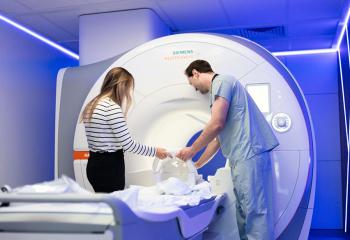
To be part of the study, Stacey needed to have an MRI, which turned out to be the ultimate twist in her health journey, discovering a tumor — Stacey had lung cancer.
Through surgery, QEII clinicians were able to take all the cancer out of Stacey’s lung, allowing her to not endure chemo and radiation therapies.
“I called Dr Weise's office and told them I basically have a clean bill of health, and we can move ahead with the stimulator surgery. Within weeks, I received the stimulator surgery. My life has changed. I don’t see negative anymore. It was a terrible situation with the pain but if it wasn’t for the pain, they probably wouldn’t have found the lung cancer until it was too late.”
While her dreams of being a motorcycle racer had to be left in the dust, Stacey acknowledges she has so much to live for now.
“Because of the care I received, I’m the happiest I’ve ever been. I won’t have the use of my arm or hand again, but the QEII saved my life. My kids still have a mom. My husband has a wife. I’m so thankful to each doctor and care member who helped me on my journey. I'm going to get to see my grandchildren grow up."
"I’m known around here as the Christmas queen. Last year I didn’t even put up a tree because I was so depressed. I'm so excited for Christmas this year that I already want to put a tree up!”