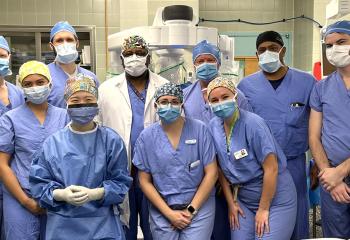


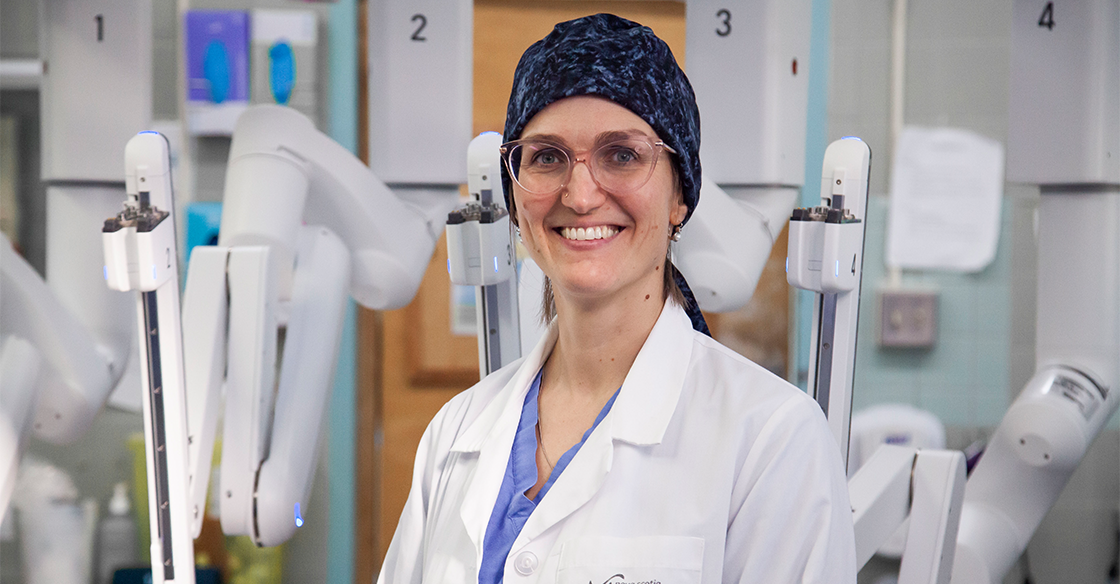
Surgeons tackling gynecological cancers are seeing the game-changing results the donor-funded da Vinci Xi robot is having within its first year of operation at the QEII Health Sciences Centre.
Thanks to generous donors of the QEII Foundation, the da Vinci Xi has been advancing surgical opportunities at the QEII since early 2026.
Dr. Lana Saciragic, a gynecological oncology surgeon at the QEII, sees firsthand how her patients are benefitting from the da Vinci Xi and other surgical robots as the QEII Foundation and Nova Scotia Health work to establish Canada’s first Centre of Excellence in Robotic Surgery.
In this Q&A, Dr. Saciragic tells us about the incredible advancements in care she is hearing and witnessing from her patients facing gynecological cancer.
_____________________
Q: What does having the da Vinci Xi meant to you and your colleagues?
A: The QEII is the central place for referrals for gynecologic cancer surgeries for all of Nova Scotia and PEI. Right now, the robot is predominantly being used by our team for endometrial cancer, and few select patients with an ovarian mass. We see about 400 patients each year, specifically with endometrial cancer. The gold standard of care for treatment of endometrial cancer is minimally invasive surgery. Before we had access to the robot, it was done laparoscopically, with small incisions, and the patients generally did quite well. However, a large percentage of endometrial cancer is associated with obesity and those with a high body mass index (BMI). And laparoscopy from a technical perspective is really hard to do in a patient who has a very high BMI. So, these patients were having big cuts up and down on their belly because that was technically the only way that you could get the uterus out, which led to them having longer healing times and hospital stays. They had more postoperative complications and so on. Since we got the da Vinci Xi robot and additional access to robotic surgery time in the operating rooms, we can prioritize those patients who would have otherwise required open surgery. And we were seeing incredible impact on that patient population, being able to not only minimize their surgical complications by shifting from big open cuts to small incisions. But we were also able to do it in a minimally invasive way and some of them are able to go home the same day.
Q: Is the gynecology team benefitting from having multiple robots at the QEII as we work to establish a Centre of Excellence in Robotic Surgery?
A: Yes. It has given more capacity for robotic surgery, and for gynecologic oncology in particular we have more OR time. As capacity has increased, we have looked to expand to not only patients with high BMI but anybody really who needs surgery for endometrial cancer or select patients with ovarian masses.
Q: Do you see a difference in your patients who receive robot-assisted surgery as compared to those who have a minimally invasive procedure?
A: It's changed a lot and it's funny because I remember before I even started doing robotic surgery, I really didn't think that there would be a difference between minimally invasive laparoscopy procedures and the robot. I thought, you know, it's kind of the same in terms of pain and issues, including small incisions. But I can tell you there is a huge difference. Most of my robotic patients report that they took a Tylenol, maybe an Advil, and that they were up walking and doing great. Whereas my laparoscopy patients, they need a bit more medications, have a little bit more fatigue. I think it's the way that the robot works, and in particular, the technology around the ports — the little things that go in the abdomen and attach to the arms of the robot — it really can[NT2] make a drastic difference in patient outcomes [for those who are eligible].
Q: With the da Vinci Xi, are you able to collaborate with other surgeons for people with multiple surgical needs?
A: Yes. Recently I did a combined case with urology. A few months ago, I did a combined case with colorectal surgery. It was a huge case where a woman needed part of her bowel removed along with her uterus for endometrial cancer. Before, a person like this would have had giant incisions and would end up having a long stay in hospital. But now we can kind of combine our surgical services and offer even more advanced procedures to patients.
Q: As a gynecological oncologist, what are you seeing more of these days?
A: Endometrial cancer is probably the bulk of the cancers we see, as well as ovarian cancer. We also treat cervical cancer, which does seem to be on the rise. Vulvar cancer as well, plus a rare condition with placentas called gestational trophoblastic neoplasia (GTN).
Q: You and your team are seeing really great results within patients. Are physicians enjoying working with the surgical robots?
A: Yes. I can tell you from a physician's point of view, it's incredible. The visualization of the anatomy that you see is amazing. I've done things on the robot that there's no way that I could have been able to see that level of detail, that precision, or physically get in there with laparoscopy or with open surgery. It's really quite incredible. So, visualization is way better. The precision is incomparable to anything that we've done before. Even the ergonomics for the surgeon are better. When you’re doing open surgery or laparoscopy, you're holding stances for a while, which can lead to chronic neck, shoulder and back pain. With the da Vinci Xi there's a console which is much better for your body. So from surgeon longevity and surgeon ergonomic pain issues, it’s much better.
Q: Has there been much of a learning curve with the da Vinci Xi for surgeons?
A: With robotic surgery, the learning curve can be steep, especially if robotics weren’t part of your medical training. But because you know the steps of the surgery, you know the anatomy, you're just kind of learning the technology and you can get good pretty fast. When you are learning to operate on the robot, you are also really well-supported from multiple angles and there is an established training program. We are now in a place where we have five gynecologic oncology robotic surgeons who are proficient, who feel that their skills are quite good and we can teach. There’s a huge interest from our trainee group to gain this skill because robotic surgery is the future. We know that people will usually stay in the province where they've trained if there are good job opportunities and equipment available. With the da Vinci Xi, we have the opportunity to recruit our future colleagues. We are currently looking to start a gynecological oncology fellowship program, which would include training them on the da Vinci Xi, which would be the first of its kind in Atlantic Canada.
Q: What would you say to donors who helped make the da Vinci Xi possible?
A: First, a huge thank you! Their contribution is incredibly impactful on the lives, not only of the women we treat, but their immediate and extended families. I can tell you for sure that people who have had robotic surgery generally recover much faster, and a lot of my patients will only take a week or two off, whereas before, with open surgery they would need 4-6 weeks. The relief on their face that they're not going to be without an income for an extended period of time is priceless. Or the relief in knowing they can get back to caring for others, whether that’s child, elder or pet care. I would also say thank you because helping fund this robot, you directly helped decrease rates of complications and the strain on the healthcare system in Nova Scotia, because those having a robotic surgery are often less likely to have a postoperative complication to need use of their family doctor or emergency department after surgery — that leaves more room for other people who need it to access it. Thank you on behalf of the trainees because they're investing in a new generation of physicians who will hopefully stay in Nova Scotia, if not Atlantic Canada. Also, we are seeing a lot of referrals to treat people for precancerous conditions of the uterus, again associated with high BMI, and who would benefit from having robotic surgery. By having more access to the robot, both within QE2, and hopefully in the community in the future, we can prevent cancer before it starts. The da Vinci Xi is also supporting important surgical quality of care research here at the QEII.
Fundraising efforts from last year’s Orchid Women’s Health Initiative’s Orchid Gala raised nearly $2 million in support of the da Vinci Xi and advancing gynecological oncology surgeries at the QEII.
The 2026 Orchid Gala is continuing to transform gynecological cancer care at the QEII by raising funds to help advance access to homologous recombination deficiency (HRD) testing through comprehensive genomic profiling (CGP) for women facing gynecologic cancers.
Gynecologic cancers are often diagnosed at advanced stages, making timely diagnosis and personalized treatment critical. HRD (Homologous Recombination Deficiency) status is a key biomarker that can help guide treatment decisions and identify patients who may benefit from therapies such as PARP inhibitors. By supporting access to comprehensive testing, Orchid Gala donors will help ensure more women receive the right treatment, from the right expert, at the right time.
If you would like to support the 2026 Orchid Gala, click here.