


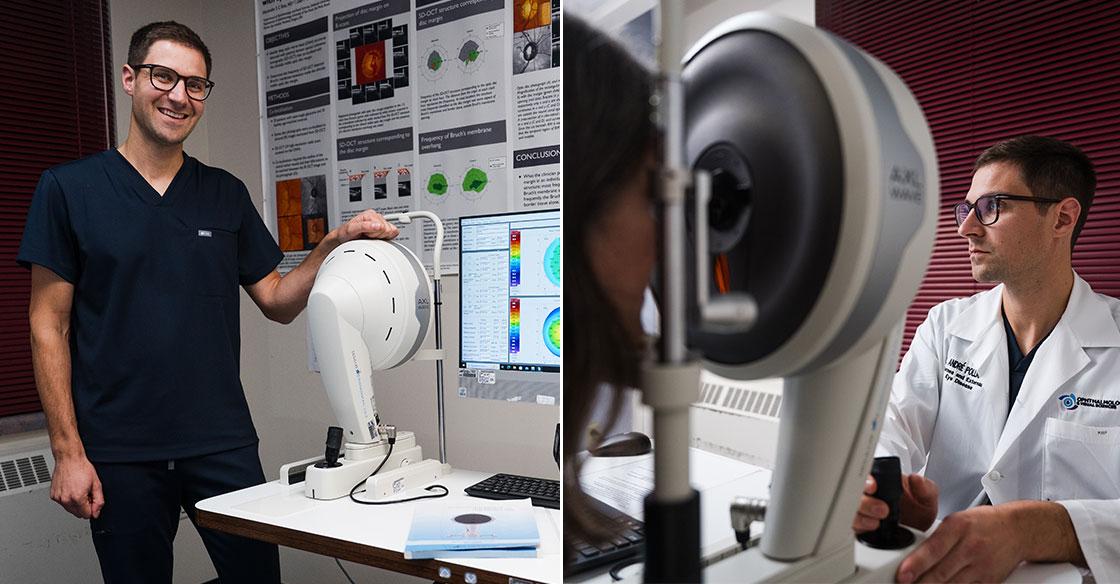
Pictured: Dr. André Pollmann with the Oculus Pentacam technology, proudly supported by QEII Foundation donors
Two Oculus Pentacam systems — made possible by QEII Foundation donor support — are helping ophthalmology teams detect disease earlier, guide more precise treatment and provide more seamless care for patients across our region.
The leading-edge technology uses a rotating camera to create detailed, 3D images of the cornea, allowing specialists to assess its shape and thickness and uncover abnormalities that can affect a patient’s vision.
Since 2021, 18,811 exams have been performed using donor-funded Oculus Pentacam technology at the QEII’s Eye Care Centre and Bayers Lake Community Outpatient Centre (BLCOC). Nearly half of those exams have taken place in just the past 16 months alone, as its role in patient care continues to grow.
According to Dr. André Pollmann — QEII ophthalmologist and cornea, cataract and external eye disease specialist — it’s what clinicians can see in those exams that makes the technology so powerful.
“It can help provide very early detection of subtle clinical changes that would potentially be missed with previous technologies we had access to,” says Dr. Pollmann.
SEEING WHAT OTHERS CAN’T
The cornea is the clear, dome-shaped window at the front of the eye and is responsible for the majority of the eye’s focusing power. Using advanced tomography, the Pentacam captures remarkably precise images of the entire cornea — including its front and back surfaces and thickness.
For Dr. Pollmann, one of the clearest examples of that technology in action is keratoconus; one of the most common corneal conditions he sees.
Keratoconus causes the cornea to become warped and irregularly shaped and can lead to significant vision loss as it progresses. The Pentacam gives specialists a detailed picture of those changes, helping them identify the condition earlier, closely monitor its progression and determine when treatment may be needed.
That ability to see more, sooner, is particularly important when much of Dr. Pollmann’s work happens before severe sight loss occurs. Approximately three-quarters of the patients he sees have minimal or low levels of vision loss, but may already be experiencing glare, halos, double vision or difficulty driving or working at a computer.
“Early detection is really important to guide treatment and prevent it from getting worse,” says Dr. Pollmann.
TWO LOCATIONS. MORE SEAMLESS CARE.
The first donor-funded Pentacam arrived at the QEII’s Eye Care Centre in 2021. When BLCOC opened in 2023, patients gained another location for ophthalmology care outside downtown Halifax — but some still needed a separate visit to the Eye Care Centre for vital Pentacam imaging.
QEII Foundation donors helped close that gap. Donations from the Oleschuk Family Foundation, Holly Murphy-Stenton and other generous supporters helped fund the technology across both locations.
With a Pentacam now available at BLCOC, imaging, assessment and treatment planning can happen in one visit for some patients. The two systems are also electronically connected, giving clinicians access to a patient’s imaging at either location.
“Having the Pentacam at both sites has really improved our workflow because we can provide that comprehensive care for cataract and cornea work directly with one patient visit,” says Dr. Pollmann.
That added access matters for patients travelling to Halifax for highly specialized eye care. The QEII’s ophthalmology teams care for patients from across Nova Scotia and throughout the Maritimes, including Prince Edward Island, New Brunswick and, in some cases, Newfoundland and Labrador.
RECRUITING SPECIALIZED TALENT
For highly specialized physicians, access to cutting-edge technology matters.
According to Dr. Pollmann, many cornea specialists train with advanced diagnostic imaging equipment, like the Pentacam, during their residency and fellowship and expect access to those same innovative tools when choosing where to build their careers.
For Halifax, that can be a recruitment advantage.
“Having that type of technology puts us on a level playing field with places like Ottawa, Toronto and Montreal,” says Dr. Pollmann.
He says access to Pentacam technology can help attract cornea specialists to the region — while not having it could make it more difficult for physicians to practise at the level they were trained to.
That investment is also helping train the next generation. Approximately two to three new ophthalmology residents begin training at the QEII each year, encountering Pentacam technology throughout their residency and taking that expertise with them into their future practice.
For Dr. Pollmann, it’s another example of donor impact that reaches far beyond the technology itself.
“Donors aren’t simply purchasing another machine — they’re investing in patient care for decades to come,” he says.