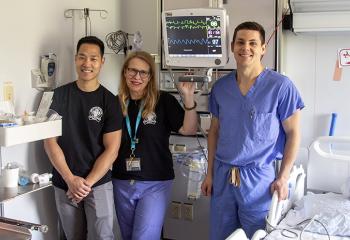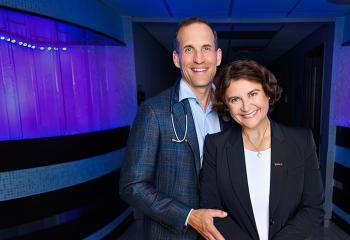


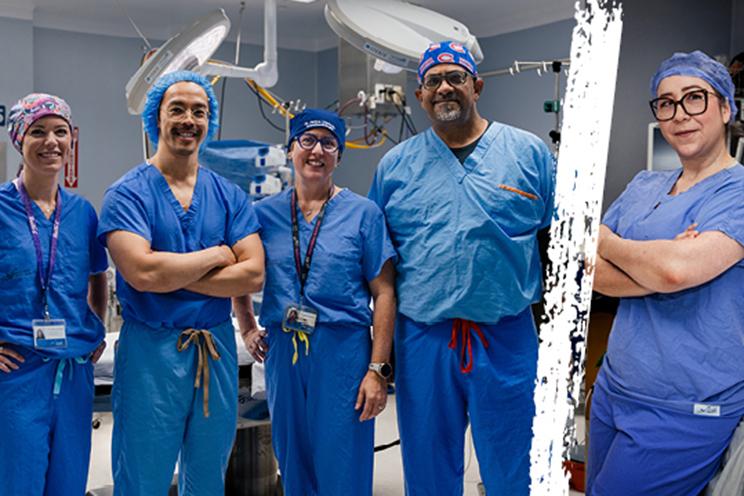
Members of the QEII's anesthesia team, (L-R) Dr. Dana Archibald, Dr. Liem Ho, Dr. Janice Chisholm, Dr. Colin Audain, and Dr. Angela Builes are passionate champions for a dedicated fleet of 18 point-of-care ultrasounds. Right now, all donations to this project will be doubled up to $211,000 thanks to Sherry Porter and Doug Hall. UNCHARTED.MEDIA; DARREN HUBLEY
QEII Foundation raising $1 million for fleet of 18 point-of-care ultrasound systems
Every surgery is built on thousands of critical decisions.
For anesthesiologists, many of those decisions happen in seconds — often while a patient's condition is changing. The more they can see, the faster and more confidently they can respond.
That's why the QEII Foundation is raising $1 million through its We Are campaign to help equip anesthesia teams across the QEII Health Sciences Centre's Halifax Infirmary and Victoria General sites with a fleet of 18 state-of-the-art point-of-care ultrasound (POCUS) systems.
Unlike traditional ultrasound, which often requires patients to be transported to an imaging department, POCUS brings imaging directly to the bedside, operating room or recovery unit. Within moments, clinicians can visualize the heart, lungs, blood vessels and other structures, helping guide procedures, diagnose complications and make lifesaving decisions when every second matters.
The impact reaches far beyond the operating room.
This technology helps anesthesiologists safely place IVs and central lines and perform nerve blocks and spinal anesthetics with greater precision. They can assess heart and lung function before surgery, identify complications earlier and provide more personalized pain management. For patients, that can mean less discomfort, fewer complications and safer, more efficient care.
"Ultrasound has completely changed the way I practice," says Dr. Angela Builes, anesthesiologist at the QEII. "When I trained, I relied on what I could hear through a stethoscope and what I believed was happening. With this imaging, I can guide procedures more safely, respond faster during emergencies and know — not just think — what is happening. It has made me a better physician and a better anesthesiologist."
As surgical care continues to evolve, so do the patients receiving it. People are living longer, undergoing more complex procedures and often arriving in the operating room with multiple health conditions. As innovations like robotic surgery continue to advance care at the QEII, anesthesia teams need equally advanced technology to support patients safely through every stage of surgery.
"We're no longer simply putting patients to sleep," says Dr. Dana Archibald, anesthesiologist at the QEII. “We're managing a patient's physiology during some of the highest-acuity moments of their care. Point-of-care ultrasound gives us real-time insight that helps us make safer decisions for our patients."
With specialized fellowship training in point-of-care ultrasound, Dr. Archibald has seen firsthand how access to this technology can completely change a patient's outcome.
"A two-minute POCUS scan can identify a serious heart condition before surgery that might otherwise go undetected," says Dr. Archibald. "It can mean the difference between safely changing a patient's care plan or facing an avoidable emergency. We also use it to improve pain management through safer nerve blocks and help patients recover more comfortably."
Its greatest impact is often felt during the unexpected. When a patient's condition suddenly changes, point-of-care ultrasound can give clinicians immediate answers — helping them identify the cause and guide treatment.
"When a patient is experiencing a medical emergency, I don't have to wonder what's happening — I can see it," says Dr. Builes. "I can see whether the treatment I'm giving is working, adjust my approach immediately and make faster, more informed decisions. In many cases, it changes the trajectory of a patient's care."
With donor support, the QEII Foundation will help ensure anesthesia teams at the region’s most specialized adult hospital have access to the latest point-of-care ultrasound technology.
"This project is about creating a fleet of portable point-of-care ultrasound systems that brings consistency, efficiency and safety across the QEII," says Dr. Janice Chisholm, head of the Department of Anesthesia, Pain Management and Perioperative Medicine for Nova Scotia Health's Central Zone. “When clinicians have access to the same advanced technology throughout a patient's surgical journey, it becomes part of everyday practice and that ultimately translates into better care."
As Dr. Chisholm explains, in an increasingly competitive environment for recruiting specialists, access to cutting-edge technology matters. The latest AI-enabled POCUS systems can support clinician education by helping users obtain and interpret ultrasound images, making them valuable tools for both experienced anesthesiologists and those developing advanced point-of-care ultrasound skills. A state-of-the-art POCUS fleet will help the QEII attract and train the next generation of anesthesiologists while supporting education, research and continued surgical innovation.
"Government funding sustains our healthcare system," says Dr. Chisholm. "Philanthropy accelerates innovation. This investment will help modernize perioperative imaging at the QEII and position our program among the leading centres in Canada."
The QEII Foundation’s POCUS fleet initiative is one of two critical diagnostic imaging projects we’re rallying behind this fall season. Thanks to the generosity of longtime QEII Foundation supporters Sherry Porter and Doug Hall, every donation will be immediately matched, dollar for dollar, up to $211,000.
To learn more about POCUS or donate now, visit QE2Foundation.ca/Diagnostic-Imaging.