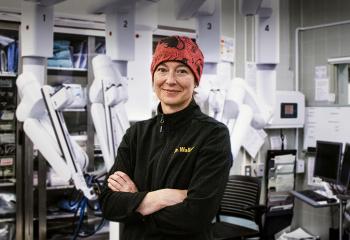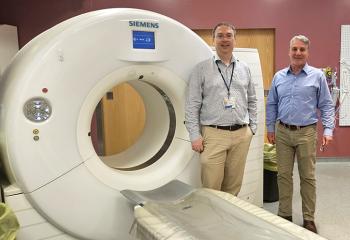


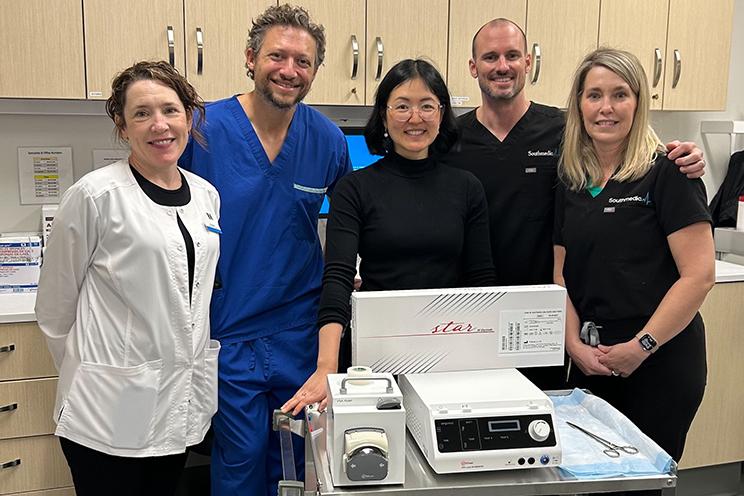
In spring 2025, QEII endocrinologist Dr. Vicki Munro (centre) introduced thyroid radiofrequency ablation (RFA) in Nova Scotia. RFA is a minimally invasive, outpatient procedure that uses heat to shrink thyroid nodules, offering an alternative to surgery. CONTRIBUTED
Thyroid radiofrequency ablation offers an alternative to surgery
It was Canada Day weekend in 2015, and Lisa Olie was relaxing in a hammock, enjoying a lazy Nova Scotia summer day.
“I fell out of the hammock and hurt the back of my neck,” the Meaghers Grant resident recalls. “It hurt enough that I went to emergency to get it checked out.”
While a scan revealed no serious damage from the fall, it did detect a lump on the front of her neck.
Followup of the nodule included regular ultrasounds and biopsies, but over the years the lump slowly grew to the point where it became visible.
“I don’t know if other people noticed it,” Lisa recalls. “But I certainly noticed it. When I swallowed, I could feel an obstruction.”
Three years ago, Lisa was referred to Dr. Vicki Munro, QEII endocrinologist and assistant professor of medicine at Dalhousie University.
It was around this time, in early 2023, that thyroid radiofrequency ablation (RFA) was approved for use in Canada. RFA is a minimally invasive, outpatient procedure that uses heat to shrink thyroid nodules, offering an alternative to surgery.
“It’s a type of heat generation that can be used to treat various tumours,” Dr. Munro explains. “It was adapted for the thyroid with a smaller probe, as the thyroid is much smaller gland than the organs it was previously used for.”
A thin needle-like probe is guided into the nodule using ultrasound. Radiofrequency energy is delivered, causing the thermal death of the cells, which the body then gradually reabsorbs, shrinking the tumour.
“The application is mostly for non-cancerous nodules,” Dr. Munro explains.
These nodules can sometimes grow very large (more than five centimetres) and begin pushing on the trachea (windpipe) and esophagus, creating pressure and difficulty with swallowing. There is also the cosmetic consideration of having a significant lump on a person’s neck.
In spring 2025, Dr. Munro introduced thyroid radiofrequency ablation in Nova Scotia, and in March of that year Lisa became one of the first people in the province to undergo the procedure. The nodule has shrunk by more than 65 per cent.
The procedure is done at the Bayers Lake Community Outpatient Centre and typically takes between 45 minutes and an hour. A local anesthetic keeps discomfort to a minimum. Lisa notes that other than minor swelling and bruising, the procedure left no aftereffects or complications.
“I had very little down time,” she recalls. “I was back to work after two days.”
Prior to the availability of RFA, the treatment option was surgery called hemithyroidectomy — removal of half the thyroid. RFA allows patients to maintain their regular thyroid function and avoid hormone replacement medication.
Dr. Munro points out that about 25 to 30 per cent of people who undergo hemithyroidectomy surgery require thyroid replacement therapy, and so preserving thyroid function is one of the key benefits of RFA.
“It’s extremely beneficial for people to be able to avoid going on lifelong medication and have their own thyroid continue to work.”
From a resource utilization perspective, the availability of RFA helps to reduce operating room wait times, which means that patients with cancerous nodules or more complex thyroid issues can access surgery sooner.
The major upfront cost was approximately $50,000 for the radiofrequency generator, which was purchased in April 2024. Funding for the project was raised through an event known as the Blue Butterfly Evening, held in support of the QEII Foundation. Held each June, this evening includes gala entertainment, food and a silent auction, with funds going to support thyroid cancer research and patient care at the QEII Health Sciences Centre. The evening features stories from survivors, with an emphasis on the importance of early detection.
Dr. Munro has treated about 15 patients since the process came online. RFA has other potential applications, she points out, including treatment of small malignant tumours, which may be offered in the future. It is also used in benign thyroid nodules that are overproducing thyroid hormone to cause hyperthyroidism (toxic adenomas).

The procedure has had an impact on Lisa’s quality of life, she says. The growth is not visible, and she no longer has discomfort when swallowing.
“I don’t know if I would have gone for the surgery, but when this option came up it seemed like a pretty easy decision to make.”