

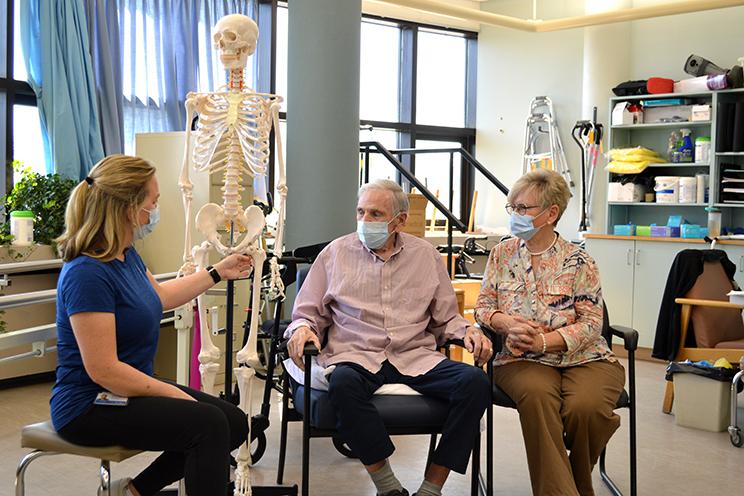
Jan Langille (left), physiotherapist at the QEII’s Camp Hill Veterans Memorial Building, speaks with Reg Campbell and his wife Sheila about his hip injury and surgical repair. The anatomical skeleton model, purchased with funds received from a QEII Foundation Comfort & Care grant, has been valuable in helping patients like Reg learn about their injury and required rehabilitation. QEII FOUNDATION
QEII Foundation grant provides valuable resources for patient education and care
QEII physiotherapist Jan Langille has a new six-foot-tall anatomical skeleton to support her work with orthopaedic geriatric patients, thanks to a QEII Foundation Comfort & Care grant.
The life-sized skeleton, with its 206 moveable bones, spinal nerves and intervertebral discs, stands on a rolling base, making it easy to move around the rehabilitation gym at the QEII’s Camp Hill Veterans Memorial Building. The gym is shared by Acute Care of the Elderly and Orthopaedic Geriatric Rehabilitation, an inpatient unit for orthopaedic patients 65 years and older, who have been at the QEII or Dartmouth General Hospital and require further rehabilitation before returning home.
“The skeleton helps patients visualize their injury,” says Jan. “Having a visual aid can help patients have a better understanding of the anatomy of their injury and provide insight to the source of their limitations. It prompts them to ask questions and builds rapport and trust. In physiotherapy, trust is important as we may be required to push patients outside of their comfort zone.”
As part of a collaborative team, including occupational therapy, recreation therapy, social work, continuing care, nutrition and a nurse practitioner, physiotherapists on the rehabilitation unit provide therapy for patients five days a week.
“Patient and family education is an important part of physiotherapy intervention,” says Jan. “If a patient has had a surgery, I will often review their pre and post op X-rays with them. With the addition of the skeleton model, I can point out where the injury is on the bone. In patients with lumbar spine issues, the model can help illustrate how irritated nerves may contribute to lower extremity pain.”
Reg Campbell spent two weeks in the Orthopedic Geriatric Rehabilitation unit in March after he fell, broke his left hip and underwent surgery at the Dartmouth General Hospital to have three pins put in his major joint. After an assessment that deemed he had the potential to make functional gains, he was transferred to ortho geriatric rehab.
During his first day in the gym, he asked Jan about the pins in his hip. She showed him his X-ray, but he couldn’t visualize where exactly they were located so she wheeled over the model, who Reg affectionately called Sammy the Skeleton.
“It was very useful because I had no idea where the break was. After being shown on Sammy the Skeleton, I knew exactly what was going on,” says Reg.
Jan also uses the anatomical skeleton to demonstrate physio exercises, understanding that informed patients are more aware of their limitations and can feel empowered to take an active role in their rehabilitation. Reg remembers how useful it was when Jan used the model to show him the alignment of his spine during a leg exercise.
“I never gave a lot of thought to my bones until I met Sammy,” says Reg, who continues his rehab exercises at home in Dartmouth to regain strength.
The physiotherapy team was able to purchase the life-sized skeleton after receiving a QEII Foundation Comfort & Care grant in 2024. Since 2005, the QEII Foundation has awarded $2.25 million in Comfort and Care grants to frontline healthcare teams to support projects that would not typically receive funding from the health centre’s operating or capital budgets.
Every year, QEII Foundation donors ensure a minimum of $100,000 in Comfort & Care grants can be awarded to QEII departments, enabling the purchase of small comforts that have an extraordinary impact and that otherwise wouldn’t be available to patients, families and healthcare teams.
“In addition to being a valuable educational tool, the skeleton brings joy to our patients by dressing up for different occasions throughout the year,” says Jan.
Recently, it was decorated with Canadian apparel to honour the country’s Olympic athletes, and it sported a cheerful green hat and scarf for St. Patrick’s Day.
For more information or to donate to the QEII Foundation's Comfort & Care grants to support patients like Reg, click here.